Research notification
Inform farmers before planting decisions
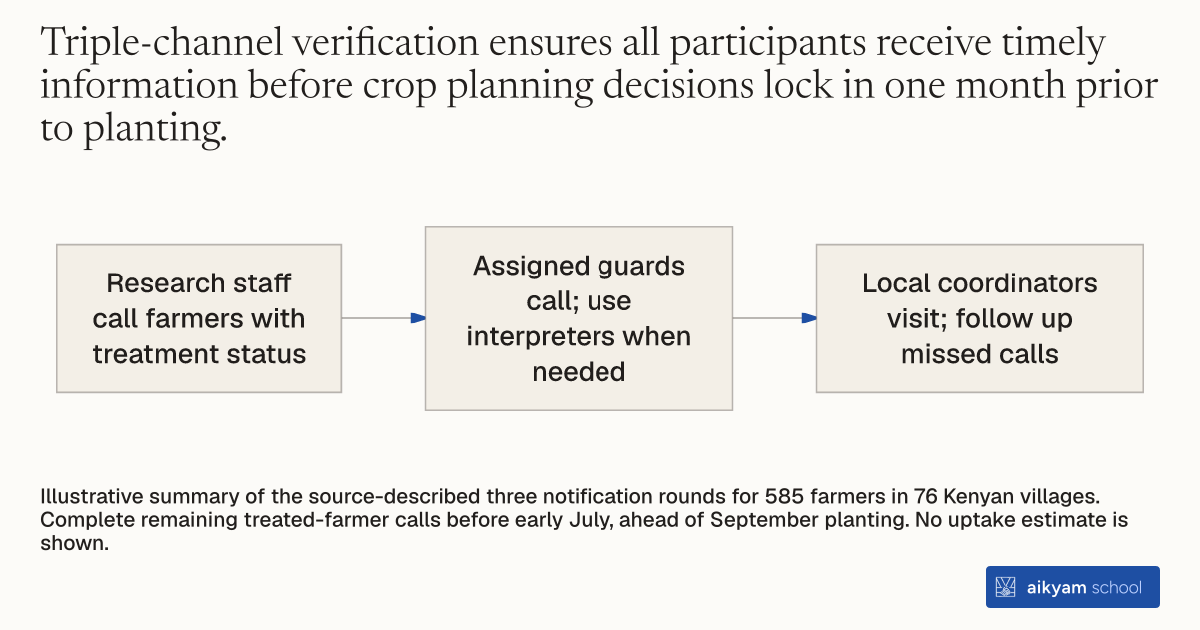
- Research staff call farmers with treatment status
- Assigned guards call; use interpreters when needed
- Local coordinators visit; follow up missed calls
Illustrative summary of the source-described three notification rounds for 585 farmers in 76 Kenyan villages. Complete remaining treated-farmer calls before early July, ahead of September planting. No uptake estimate is shown.
See source →How
When to use
Field experiments testing agricultural decisions require participants to know their intervention status well before planting starts. Simple single-channel messages often fail to reach remote smallholders or overcome language barriers. This method delivers credible treatment information across multiple channels to ensure complete comprehension prior to crop planning.
Inform trial participants of their assigned treatment status through three complementary communication rounds prior to decision deadlines.
- Call participating farmers via research centre staff to notify them of their treatment status and prepare treated farmers for guard contact.
- Direct watchman coordinators to ensure each assigned guard calls their matched farmer within a designated timeframe.
- Provide local language interpreters during guard calls whenever watchmen and farmers struggle to communicate in Swahili.
- Dispatch local farmer coordinators to follow up in person with participants to verify they understand their treatment assignment.
- Report uncontacted treated farmers back to the watchman coordinator to complete remaining calls before early July.
Why it works
Using local language translation resolves communication frictions between outsider guards and local smallholders.
Example
Research teams in Migori County, Kenya delivered three rounds of notification to 585 trial farmers across 76 villages by early July 2018. Over 86% of offered farmers successfully hired watchmen before the September planting season.
About the study
Participants
585 smallholding farmers across 76 villages in Suna East, Suna West, and Uriri sub-counties, Migori County, Kenya.
Study Design
Cluster-randomized field experiment testing the timing and uptake of watchman offers across three notification stages (research call, watchman call with translation, and local coordinator visit).
Results
Three-phase notification completed by early July achieved an 86% take-up rate among treated farmers and enabled 14 percentage points more farmers to adjust crop choices due to improved security.