Research steps
Map reported harassment hotspots
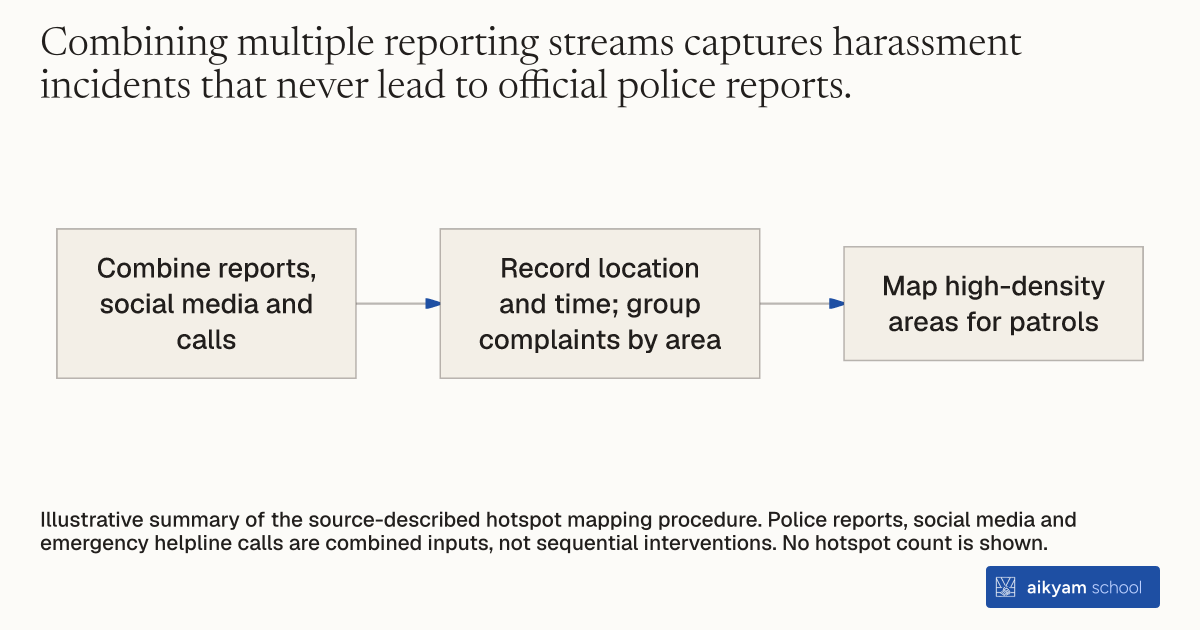
- Combine reports, social media and calls
- Record location and time; group complaints by area
- Map high-density areas for patrols
Illustrative summary of the source-described hotspot mapping procedure. Police reports, social media and emergency helpline calls are combined inputs, not sequential interventions. No hotspot count is shown.
See source →How
When to use
Urban police departments often lack accurate data on street harassment because victims rarely file formal complaints. Relying only on station records leaves safety blind spots across public transit and commercial areas. Map high-risk public spaces by aggregating multiple reporting channels to target police patrols effectively.
Aggregate diverse public report channels and police data to identify and map harassment hotspots across a city.
- Connect data streams from official police reports, social media monitoring, and emergency police helpline calls.
- Record the geographic location and time for every reported harassment complaint.
- Group incident reports to find public areas with high concentrations of harassment.
- Select the highest-density areas to create a master list of designated harassment hotspots.
- Map these hotspots into standard geographic units to assign police patrol teams.
Why it works
Triangulating helpline calls and social media data reveals exact geographic concentrations of street harassment.
Example
Hyderabad City Police and researchers tracked police reports, social media posts, and helpline calls to map 350 harassment hotspots across Hyderabad, India, for a randomized evaluation.
About the study
Participants
350 hotspots in Hyderabad, India.
Study Design
Identification and randomized assignment of 350 harassment hotspots into undercover patrol, uniformed patrol, and comparison groups.
Results
Triangulating multi-source data successfully mapped 350 hotspots; assigning uniformed patrols to 100 mapped hotspots reduced severe sexual harassment by 27 percent compared to unpatrolled hotspots.