Research measures
Combine election evidence
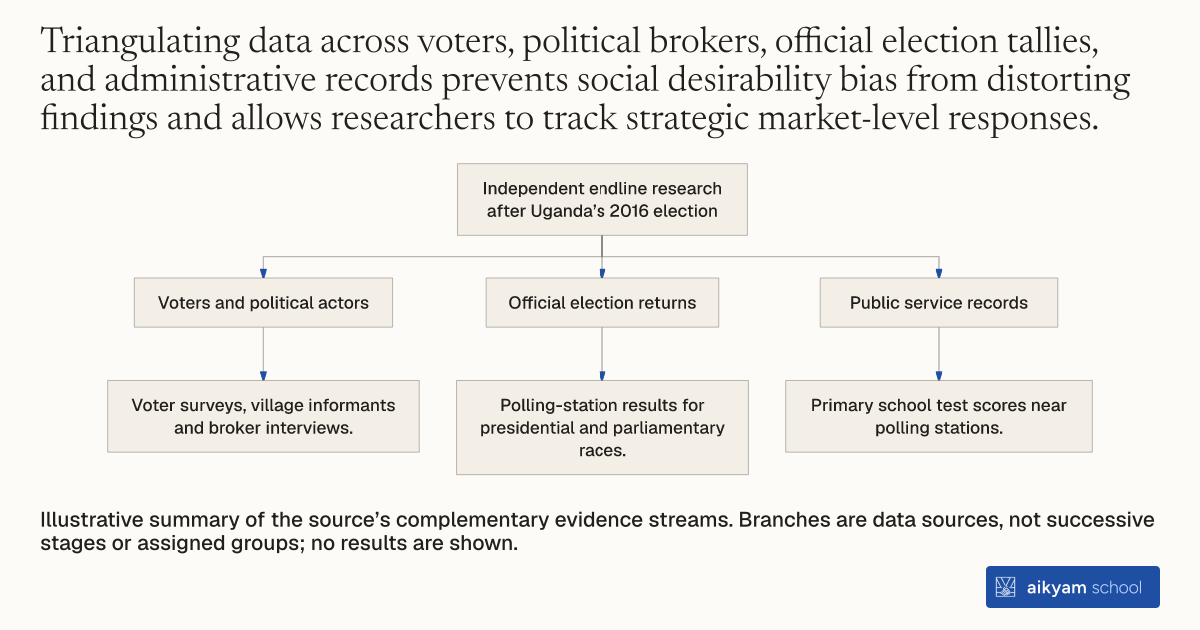
Independent endline research after Uganda’s 2016 election
- Voters and political actors
- Voter surveys, village informants and broker interviews.
- Official election returns
- Polling-station results for presidential and parliamentary races.
- Public service records
- Primary school test scores near polling stations.
Illustrative summary of the source’s complementary evidence streams. Branches are data sources, not successive stages or assigned groups; no results are shown.
See source →How
When to use
In large-scale political and social field trials, relying on a single data source can introduce reporting biases, miss behavioral responses across different actors, or lack statistical power. Researchers and evaluators need a multi-tiered data collection framework to evaluate complex interventions that affect voters, political figures, and institutional service delivery. Combining large-sample household surveys, key informant interviews, broker surveys, administrative election results, and public service metrics captures comprehensive direct and spillover impacts.
Combine voter surveys, key informant interviews, broker surveys, official election returns, and administrative performance data to measure intervention impacts across multiple political actors.
- Deploy an independent research organization with no ties to implementing civil society groups to conduct endline field data collection.
- Sample registered voters randomly from official polling station registers, stratifying by age and gender categories.
- Interview one key informant per village and conduct structured surveys with campaign brokers operating for opposing political candidates.
- Collect polling-station level administrative voting returns from official electoral commissions for presidential and parliamentary races.
- Gather objective administrative service performance metrics, such as standardized national primary school test scores, near each polling station.
Why it works
Cross-referencing subjective survey responses with official voting tallies validates behavioral reports and measures long-run institutional spillovers.
Example
Following Uganda's 2016 general election, independent researchers surveyed 28,454 registered voters, interviewed key informants across 4,090 villages, surveyed 438 political brokers, and matched official election results across 1,585 polling stations and test score metrics across 2,052 polling stations.
About the study
Participants
28,454 registered voters across 918 parishes, 4,090 village key informants, 438 political brokers, 3,657 polling stations, and 2,052 primary schools in Uganda.
Study Design
Multi-source endline data collection following a two-level randomized saturation design, linking household surveys, village informant interviews, broker surveys, official 2016 and 2021 election returns, and 2016-2017 primary school leaving exam test scores.
Results
Recorded an 0.18 standard deviation drop in incumbent vote share in fully treated parishes in both voter survey data and official election data, while primary school test scores near treated polling stations increased by 0.19 to 0.21 standard deviations.