Research procedure
Plan follow-up into adulthood
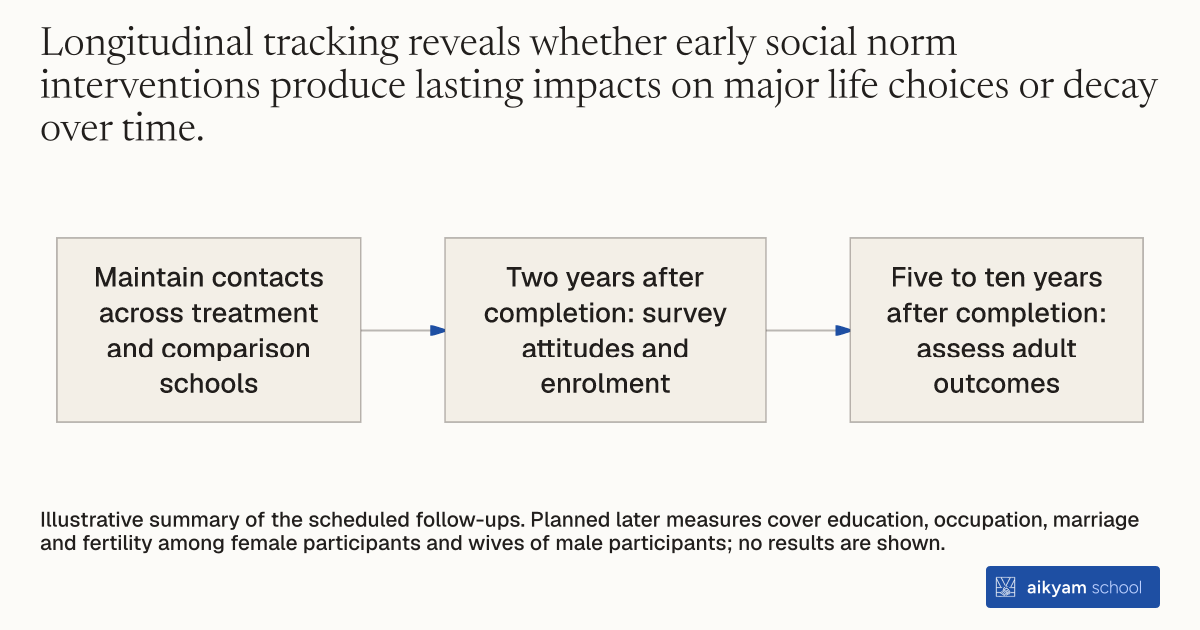
- Maintain contacts across treatment and comparison schools
- Two years after completion: survey attitudes and enrolment
- Five to ten years after completion: assess adult outcomes
Illustrative summary of the scheduled follow-ups. Planned later measures cover education, occupation, marriage and fertility among female participants and wives of male participants; no results are shown.
See source →How
When to use
Adolescent attitude shifts may decay over time or fail to translate into adult life choices. This method tracks program participants across multi-year follow-up stages into young adulthood. It serves researchers and evaluators measuring the long-term persistence of social norm interventions.
Track participants across multi-year post-program stages to evaluate whether adolescent attitude shifts persist into key adult life decisions.
- Evaluators maintain contact details for enrolled students across treatment and comparison schools.
- Field researchers re-survey study participants two years after program completion to assess attitude persistence and school enrollment.
- Field researchers design long-term survey protocols to trace female participants and male participants.
- Field researchers re-contact study participants five to ten years after program completion during young adulthood.
- Evaluators measure long-term adult outcomes including completed educational attainment, occupational choice, age at marriage, and fertility.
Why it works
Measuring key adult milestones helps evaluators determine whether changed adolescent beliefs successfully overcome broader structural and societal barriers.
Example
Researchers established a multi-stage longitudinal evaluation tracking students from 314 government schools in Haryana, India, scheduling follow-up surveys two years post-program for school enrollment and five to ten years post-program for education, employment, marriage, and fertility.
About the study
Participants
Nearly 15,000 students in grades 7–8 (aged 11–15) across 314 government schools in Haryana, India.
Study Design
Longitudinal follow-up study integrated into a school-level cluster randomized controlled trial with tracking scheduled at 2 years and 5–10 years post-intervention.
Results
Research design targets tracking attitude persistence at 2 years and measuring completed education, career choices, marriage, and fertility at 5 to 10 years among female participants and wives of male participants.