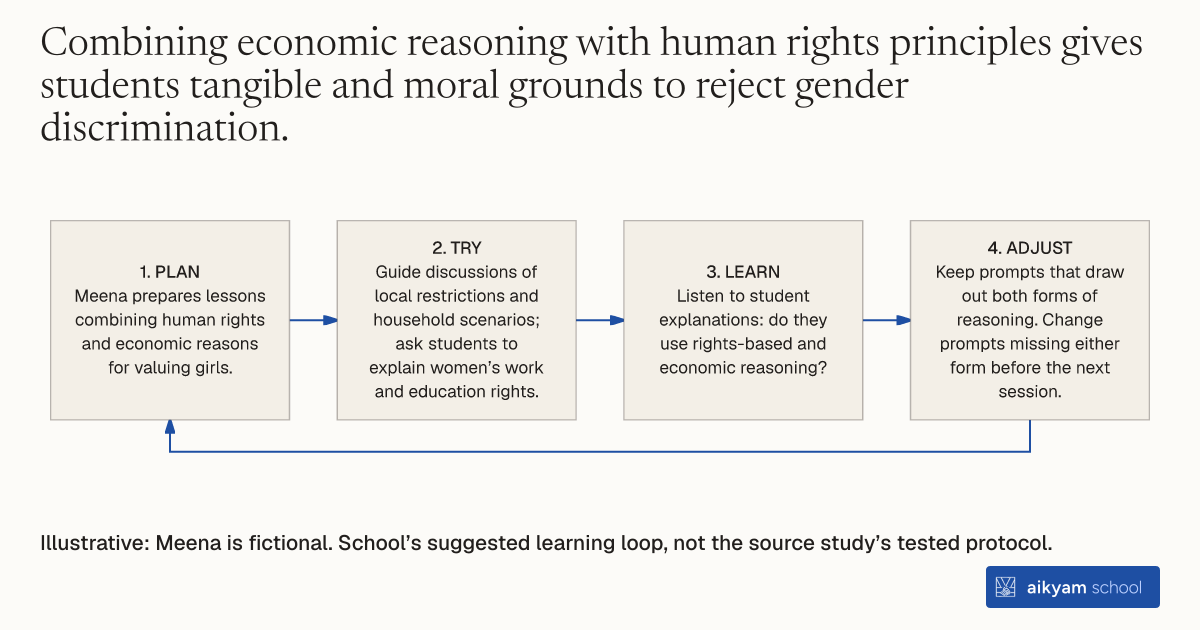
Try, learn and adjust
Check use of both equality arguments
- Plan: Meena prepares lessons combining human rights and economic reasons for valuing girls.
- Try: Guide discussions of local restrictions and household scenarios; ask students to explain women’s work and education rights.
- Learn: Listen to student explanations: do they use rights-based and economic reasoning?
- Adjust: Keep prompts that draw out both forms of reasoning. Change prompts missing either form before the next session.
Illustrative: Meena is fictional. School’s suggested learning loop, not the source study’s tested protocol.
See source →School’s suggested learning loop checks discussion content, separately from the tested curriculum as a whole.
How
When to use
Adolescents often internalise gender bias without considering the practical and ethical reasons for equality. This method provides a persuasive messaging framework combining economic benefits with human rights principles. It serves educators and program developers designing gender equality curricula for secondary school students.
Combine economic arguments and human rights principles within educational materials to promote gender equality.
- Curriculum developers frame girls' rights as fundamental human entitlements across session materials.
- Facilitators present long-term economic gains of educating girls, such as improved health for future children.
- Facilitators lead guided discussions comparing local social restrictions against universal rights and economic evidence.
- Facilitators prompt students to debate practical household scenarios using both economic and rights-based reasoning.
- Students practice articulating reasons why women should be allowed to work outside the home and attend higher education.
Why it works
Highlighting practical future benefits alongside human rights helps adolescents re-evaluate entrenched community norms.
Example
Breakthrough applied this dual messaging framework across 27 sessions in 150 government schools in Haryana, India. The curriculum increased the likelihood that students believed women should be allowed to work outside the home by 12.9 percentage points and pursue far-away college education by 8.4 percentage points.
About the study
Participants
Nearly 15,000 students in grades 7–8 (aged 11–15) across 314 government schools in Haryana, India.
Study Design
School-level cluster randomized controlled trial evaluating 150 treatment schools receiving the persuasive messaging curriculum against 164 comparison schools.
Results
Students believing women should be allowed to work outside the home increased by 12.9 percentage points, students believing women should be allowed to attend distant college increased by 8.4 percentage points, and overall gender attitude index increased by 0.25 standard deviations.