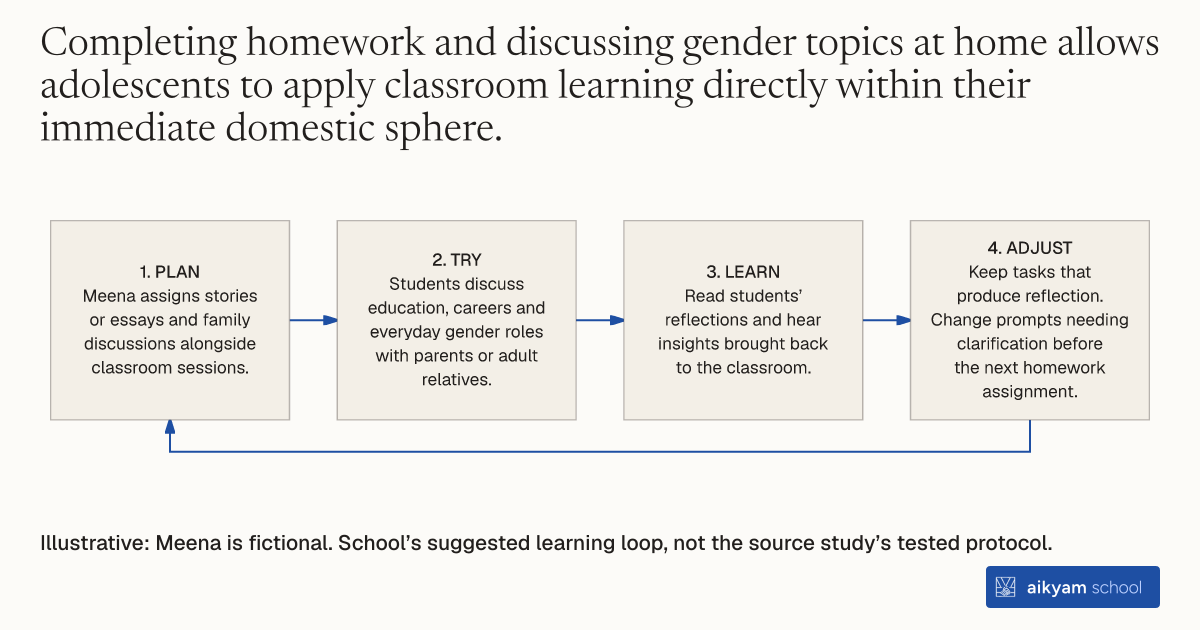
Try, learn and adjust
Check reflection on gender homework
- Plan: Meena assigns stories or essays and family discussions alongside classroom sessions.
- Try: Students discuss education, careers and everyday gender roles with parents or adult relatives.
- Learn: Read students’ reflections and hear insights brought back to the classroom.
- Adjust: Keep tasks that produce reflection. Change prompts needing clarification before the next homework assignment.
Illustrative: Meena is fictional. School’s suggested learning loop, not the source study’s tested protocol.
See source →School’s suggested learning loop checks student reflection, separately from the programme’s homework component; it does not isolate homework effects.
How
When to use
Adolescent gender attitudes are heavily influenced by household environments and parental views. This method extends school-based gender curricula into students' homes through structured family interactions and creative tasks. It helps adolescents engage family members in conversations around equitable gender roles and individual rights.
Assign structured out-of-classroom tasks to secondary school students to reinforce classroom gender equality topics at home.
- Teachers or facilitators assign experiential homework tasks alongside classroom sessions.
- Students write stories or essays focused on gender discrimination and equal opportunities.
- Students initiate structured discussions about educational and career goals with their parents or adult relatives.
- Students discuss everyday gender roles and domestic expectations with family members at home.
- Students reflect on their family's perspectives and bring insights back to subsequent classroom sessions.
Why it works
Engaging relatives encourages reflection on family expectations and builds parental awareness around students' educational and career aspirations.
Example
Students in 150 government schools in Haryana, India, completed home assignments alongside 27 classroom sessions, with 84 percent of boys and 80 percent of girls discussing their education goals with a parent. The overall program improved the gender attitude index by 0.25 standard deviations and increased gender-equitable behavior by 0.32 standard deviations.
About the study
Participants
Nearly 15,000 students in grades 7–8 (aged 11–15) across 314 government schools in Haryana, India.
Study Design
School-level cluster randomized controlled trial evaluating 150 treatment schools receiving the program with homework components against 164 comparison schools.
Results
Gender attitude index increased by 0.25 standard deviations, gender behavior index increased by 0.32 standard deviations (0.46 for boys, 0.21 for girls), and baseline rates showed 84 percent of boys and 80 percent of girls discussed education goals with parents.