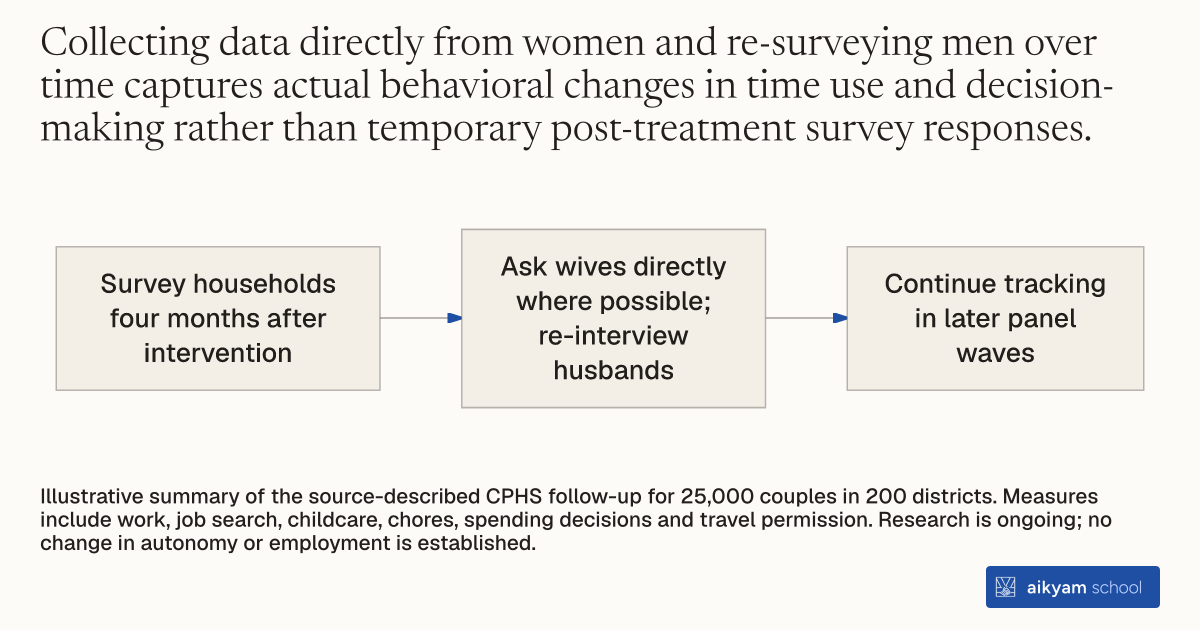
Research steps
Track employment, time use and autonomy
- Survey households four months after intervention
- Ask wives directly where possible; re-interview husbands
- Continue tracking in later panel waves
Illustrative summary of the source-described CPHS follow-up for 25,000 couples in 200 districts. Measures include work, job search, childcare, chores, spending decisions and travel permission. Research is ongoing; no change in autonomy or employment is established.
See source →How
When to use
In social norm interventions targeting household decisions, short-term shifts in attitude may not automatically lead to long-term changes in behavior or decision-making power. Female labor market entry and intra-household power dynamics require continuous, detailed monitoring over time. This method tracks behavioral changes in female labor participation, time allocation, and decision-making autonomy across treatment and comparison households.
Measure long-term changes in household labor allocation, time use, and female empowerment through repeated panel survey tracking.
- Researchers integrate follow-up survey modules into the Consumer Pyramids and Household Survey four months after the norm-information intervention.
- Field staff survey household members directly, interviewing wives whenever possible to record labor force participation, willingness to work, and job search behaviors.
- Surveyors collect detailed time-use data on hours allocated to labor market activities, childcare activities, and household chores.
- Surveyors ask wives detailed questions regarding job search intensity, search methods, workplace nature, and distance from home to workplace.
- Field staff assess female autonomy and empowerment by asking whether wives make or contribute to household spending decisions and where they can travel without permission.
- Surveyors re-interview married men on their personal gender views, peer belief estimates, and perceptions of working women's earnings and safety risks.
- Researchers continue tracking long-term household outcomes through subsequent waves of the panel survey.
Why it works
Integrating questions into an established panel survey allows researchers to track sustained economic and social impacts across multiple post-intervention periods.
Example
Researchers tracked 25,000 married couples in 200 Indian districts four months after an information intervention using the Consumer Pyramids and Household Survey to measure time use, job search, and female decision-making autonomy.
About the study
Participants
25,000 married couples with working-age wives (18 to 55 years old) across 200 districts in urban and rural India.
Study Design
Randomized controlled trial panel follow-up (Wave 3) administered four months post-intervention via the Consumer Pyramids and Household Survey, interviewing wives directly where possible.
Results
Research ongoing; results forthcoming.