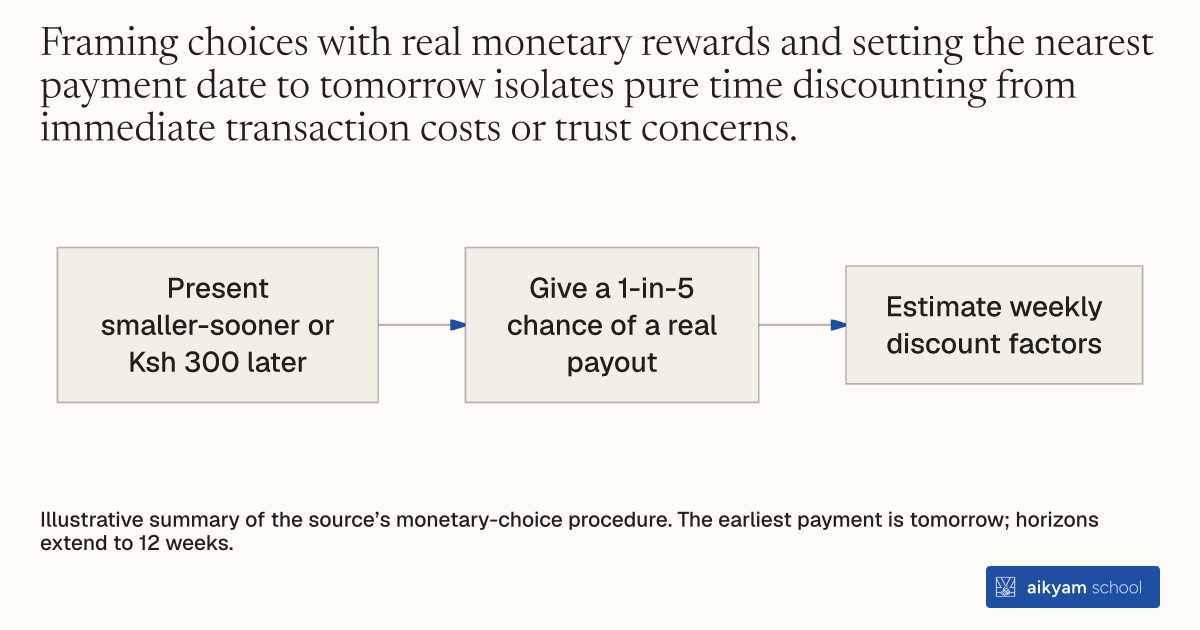
Research procedure
Elicit preferences over payment timing
- Present smaller-sooner or Ksh 300 later
- Give a 1-in-5 chance of a real payout
- Estimate weekly discount factors
Illustrative summary of the source’s monetary-choice procedure. The earliest payment is tomorrow; horizons extend to 12 weeks.
See source →How
When to use
Researchers need to measure individual discount factors and intrahousehold time preference heterogeneity among low-income couples. Self-reported savings motives often fail to quantify individual patience precisely. Structured monetary choice experiments allow researchers to estimate parametric discount factors and identify spousal preference misalignment.
Elicit individual time preferences through structured choices between smaller immediate rewards and larger delayed payments.
- Administer ten choice tables to each spouse individually, presenting five binary choices per table between a smaller sooner amount and Ksh 300 later.
- Set the nearest delivery time to tomorrow instead of today to hold transaction costs and trust constant across time horizons.
- Vary time horizons across tables using ten combinations of near and far weeks up to 12 weeks.
- Provide a real financial incentive by giving each participant a 1-in-5 chance of winning cash based on one randomly selected choice.
- Estimate individual weekly discount factors using nonlinear least squares assuming linear utility and logistic decision error.
Why it works
Parametrically estimating discount factors from multiple price lists enables precise measurement of spousal match quality.
Example
In Western Kenya, 544 husbands and wives completed 70 monetary choices each during baseline surveys, revealing average weekly discount factors of 0.72 for men and 0.70 for women, with spousal discount factors differing by nearly 0.5 standard deviations in the median couple.
About the study
Participants
1,088 individuals (544 married couples) in Western Kenya, with median weekly earnings of Ksh 700 for men and Ksh 300 for women.
Study Design
Individual baseline survey administration of 10 monetary choice tables (70 choices total) with a 20 percent probability of cash payout, followed by nonlinear least squares estimation of weekly discount factors.
Results
Weekly discount factors averaged 0.72 for husbands and 0.70 for wives, 12 percent of couples had identical estimated discount factors, and spousal discount factors had a low correlation coefficient of 0.09.