Research procedure
Update the retailer census
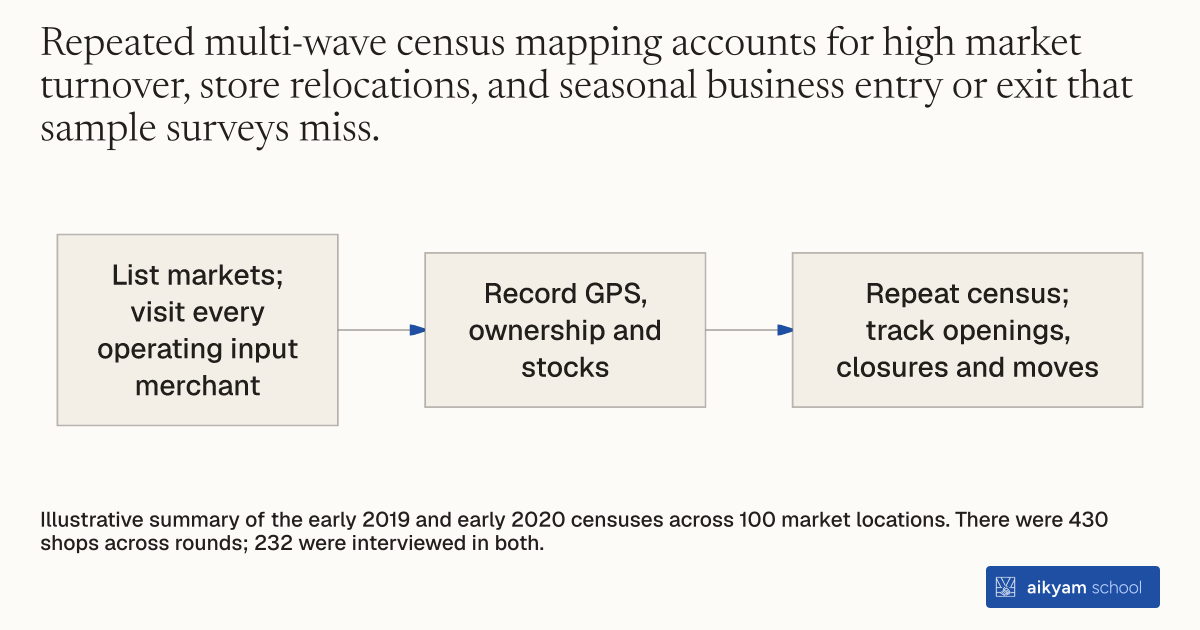
- List markets; visit every operating input merchant
- Record GPS, ownership and stocks
- Repeat census; track openings, closures and moves
Illustrative summary of the early 2019 and early 2020 censuses across 100 market locations. There were 430 shops across rounds; 232 were interviewed in both.
See source →How
When to use
Rural agricultural input markets experience high merchant turnover, seasonal business closures, and frequent store relocations. Standard sample surveys based on static business registries fail to locate active merchants or measure total retail supply capacity. Program managers use this method to construct complete, multi-wave census registries of operating agricultural retailers across target markets.
Map and track every operating rural input retailer across all regional market locations using repeated full-coverage enterprise censuses.
- Field teams compile an initial registry listing all commercial market locations across the target region.
- Enumerators visit every identified market location prior to the main agricultural trading season.
- Field teams survey every operating agricultural input merchant in person, recording store GPS coordinates, owner characteristics, and inventory status.
- Surveyors document business closures, seasonal operation windows, shop relocations, and new store openings across market rounds.
- Researchers update the complete enterprise census directory across subsequent agricultural seasons to maintain an accurate merchant sampling frame.
Why it works
Direct physical mapping ensures that evaluation surveys and intervention activities reach the complete active merchant population.
Example
Researchers conducted baseline and endline enterprise census mapping across 100 rural market locations in Morogoro Region, Tanzania. Survey teams mapped 430 total agro-dealer enterprises across survey rounds, documenting that high market churning resulted in only 232 shops operating and interviewed across both survey rounds.
About the study
Participants
Census covering 430 agro-dealer enterprises across 100 rural market locations in Morogoro Region, Tanzania.
Study Design
Repeated multi-wave regional enterprise census conducted in early 2019 (baseline) and early 2020 (endline) recording store GPS coordinates, operational continuity, and market turnover.
Results
Census mapping identified 430 total agro-dealer shops across rounds, revealing high market turnover where 22% of baseline firms exited and only 232 dealers were operating and interviewed in both survey rounds.