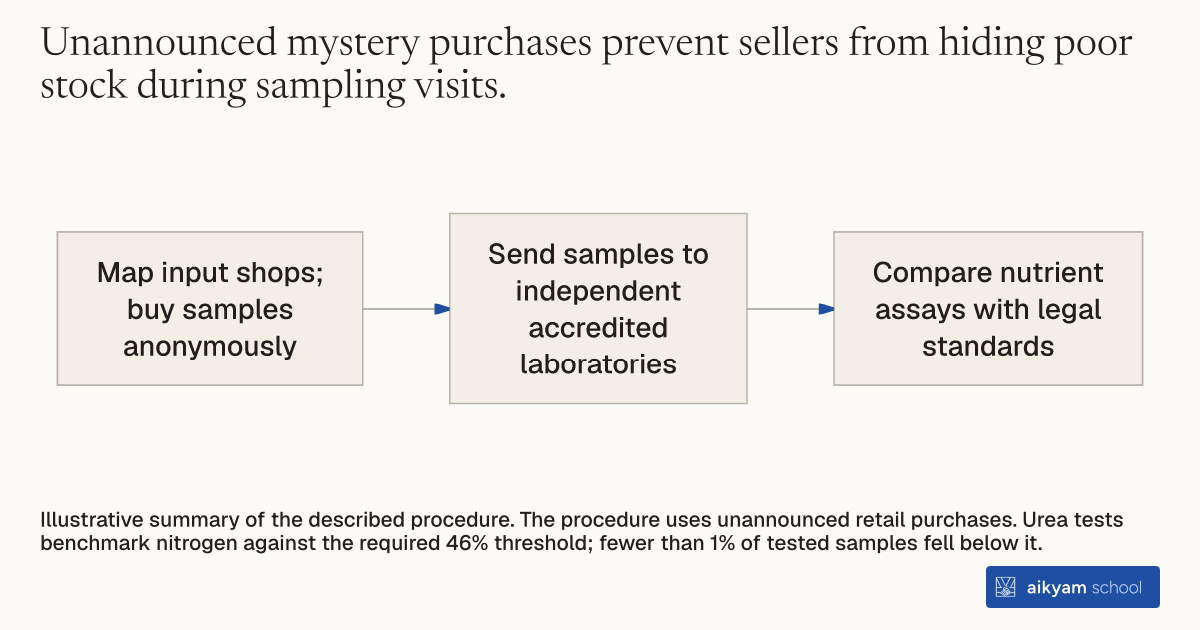
Research procedure
Test fertiliser bought by mystery shoppers
- Map input shops; buy samples anonymously
- Send samples to independent accredited laboratories
- Compare nutrient assays with legal standards
Illustrative summary of the described procedure. The procedure uses unannounced retail purchases. Urea tests benchmark nitrogen against the required 46% threshold; fewer than 1% of tested samples fell below it.
See source →How
When to use
Smallholder farmers often distrust commercial agricultural inputs because active nutrients are unobservable at purchase. This suspicion reduces input adoption even when market products meet official standards. Program managers use this method to uncover actual product quality across local retail markets.
Deploy mystery shoppers to buy retail input samples anonymously and verify active ingredient levels in accredited chemical laboratories.
- Map every retail shop selling target agricultural inputs across the designated geographic region.
- Send mystery shoppers to visit each retail shop without disclosing the research purpose.
- Purchase standard retail quantities of target inputs like one-kilogram bags of urea fertiliser.
- Transport all collected samples to independent accredited laboratories.
- Run chemical assays to measure the exact percentage weight of active nutrients.
- Benchmark laboratory results against legal standards to evaluate total market compliance.
Why it works
Accredited laboratory assays generate definitive evidence regarding whether quality concerns are real or misperceived.
Example
Mystery shoppers purchased urea fertiliser samples from all agro-dealers across market towns in Morogoro Region, Tanzania. Researchers shipped these samples to laboratories at the World Agroforestry Centre in Nairobi and Thornton Laboratory in the United States. Laboratory assays revealed that less than 1% of urea samples fell below the required 46% nitrogen threshold.
About the study
Participants
Retail agro-dealers across 100 markets in Morogoro Region, Tanzania.
Study Design
Comprehensive regional agro-dealer census combined with unannounced mystery shopper sampling and dual independent laboratory chemical testing.
Results
Chemical testing established that less than 1% of tested urea fertiliser samples had less than the required 46% nitrogen.