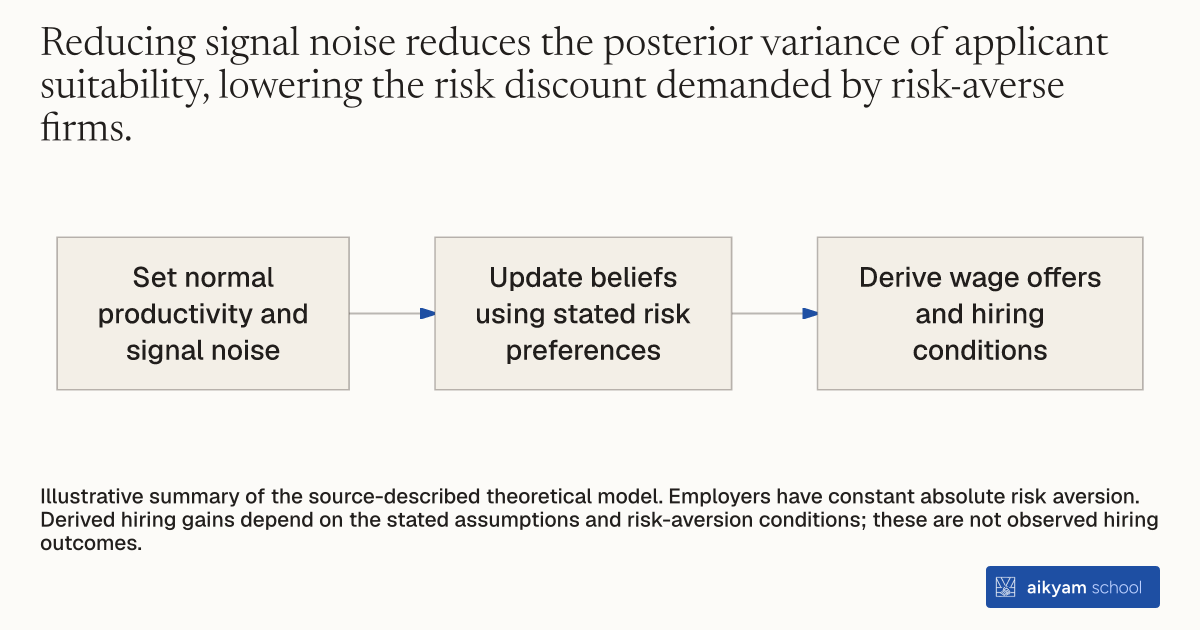
Research steps
Model employers’ assessment of noisy signals
- Set normal productivity and signal noise
- Update beliefs using stated risk preferences
- Derive wage offers and hiring conditions
Illustrative summary of the source-described theoretical model. Employers have constant absolute risk aversion. Derived hiring gains depend on the stated assumptions and risk-aversion conditions; these are not observed hiring outcomes.
See source →How
When to use
Risk-averse employers evaluate job applicants with unobservable productivity and noisy skill signals. Unobservable capabilities lead risk-averse firms to demand risk discounts or reject qualified candidates. Model the Bayesian signal-processing choices of risk-averse hiring managers to determine how lowering signal variance affects hiring probabilities.
Model the Bayesian signal-updating process of risk-averse employers evaluating job applicants with unobservable ability.
- Assume applicant true productivity follows a normal distribution with known population mean and variance.
- Model candidate skill signals received by firms as true productivity plus normally distributed random noise.
- Express employer risk preferences using a Constant Absolute Risk Aversion utility function.
- Calculate the firm's posterior mean and posterior variance of applicant productivity following Bayesian signal updating.
- Derive the firm's certainty equivalent wage offer incorporating the posterior variance penalty.
- Determine the analytical conditions under which reducing signal noise strictly increases unconditional hiring probability and match quality.
Why it works
This increases the firm's expected match payoff and raises the unconditional probability that an applicant's posterior mean exceeds the hiring threshold.
Example
Researchers modeled risk-averse firms evaluating young job-seekers in Addis Ababa, Ethiopia. The theoretical framework proved that reducing signal variance enables firms to make better assessments, increasing expected match values and unconditional hiring probabilities for risk aversion coefficients below 1.2533.
About the study
Participants
Theoretical signal-inference framework calibrated for job applicants and risk-averse firms with Constant Absolute Risk Aversion preferences.
Study Design
Bayesian signal-processing model assuming normal productivity distributions and normal noise structures evaluated under CARA utility functions.
Results
Proved that reducing signal variance strictly increases expected wage offers and unconditional hiring probabilities provided the firm's absolute risk aversion coefficient remains below 1.2533.