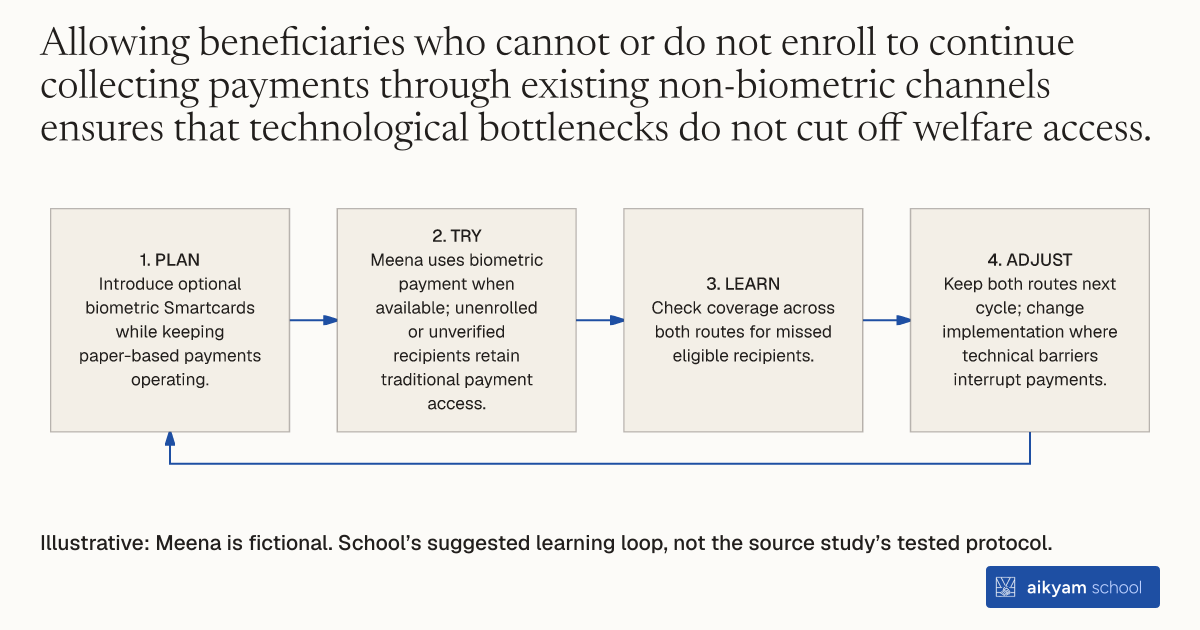
Try, learn and adjust
Check both payment routes remain accessible
- Plan: Introduce optional biometric Smartcards while keeping paper-based payments operating.
- Try: Meena uses biometric payment when available; unenrolled or unverified recipients retain traditional payment access.
- Learn: Check coverage across both routes for missed eligible recipients.
- Adjust: Keep both routes next cycle; change implementation where technical barriers interrupt payments.
Illustrative: Meena is fictional. School’s suggested learning loop, not the source study’s tested protocol.
See source →School’s suggested learning loop; not a tested source procedure. Observe payment access for enrolled, unenrolled and unverified recipients. Do not make biometric enrolment a condition of payment.
How
When to use
When introducing new biometric payment technology for social welfare programs where technical or enrollment hurdles could cause severe payment disruptions. Maintaining a non-mandatory dual-track rollout allows beneficiaries facing enrollment difficulties or technical verification failures to continue receiving government payments through traditional channels. This prevents the accidental exclusion of vulnerable rural households during major administrative transitions.
Maintain optional access to traditional payment streams alongside new biometric smartcards to prevent beneficiary exclusion during technological transitions.
- Government authorities introduce biometric smartcards as an optional upgraded payment method for social assistance beneficiaries.
- Program administrators conduct voluntary local enrollment drives while keeping standard paper-based distribution systems operational.
- Registered beneficiaries collect cash payments using biometrically authenticated smartcard readers when available in their villages.
- Unenrolled or unverified beneficiaries continue collecting scheduled welfare payments through traditional paper identity records and local officials.
- Administrative leadership monitors payment coverage across both streams to ensure no legitimate recipient is denied benefits due to technological barriers.
Why it works
A dual-track system protects vulnerable populations from exclusion while giving officials time to address implementation challenges and build enrollment capacity gradually.
Example
In Andhra Pradesh, the state government launched the Smartcard system across eight districts without making biometric authentication strictly mandatory for receiving funds. Despite partial implementation where only 50 percent of total payments were processed via smartcards after two years, overall program access did not drop, and NREGS participation increased by 17 percent (a 7 percentage point increase relative to 42 percent in the comparison group).
About the study
Participants
8,000 households in 8 districts of Andhra Pradesh, covering a rural population of nineteen million people.
Study Design
Cluster-randomized controlled trial across 296 sub-districts randomly assigned to early rollout (treatment) or delayed rollout (comparison) over two years.
Results
Maintaining non-mandatory payments prevented negative impacts on vulnerable households, yielding a 17 percent increase in NREGS participation (7 percentage points higher than the comparison group's 42 percent baseline) and zero negative impact on SSP program access.