Research steps
Provide goodwill gifts during control surveys
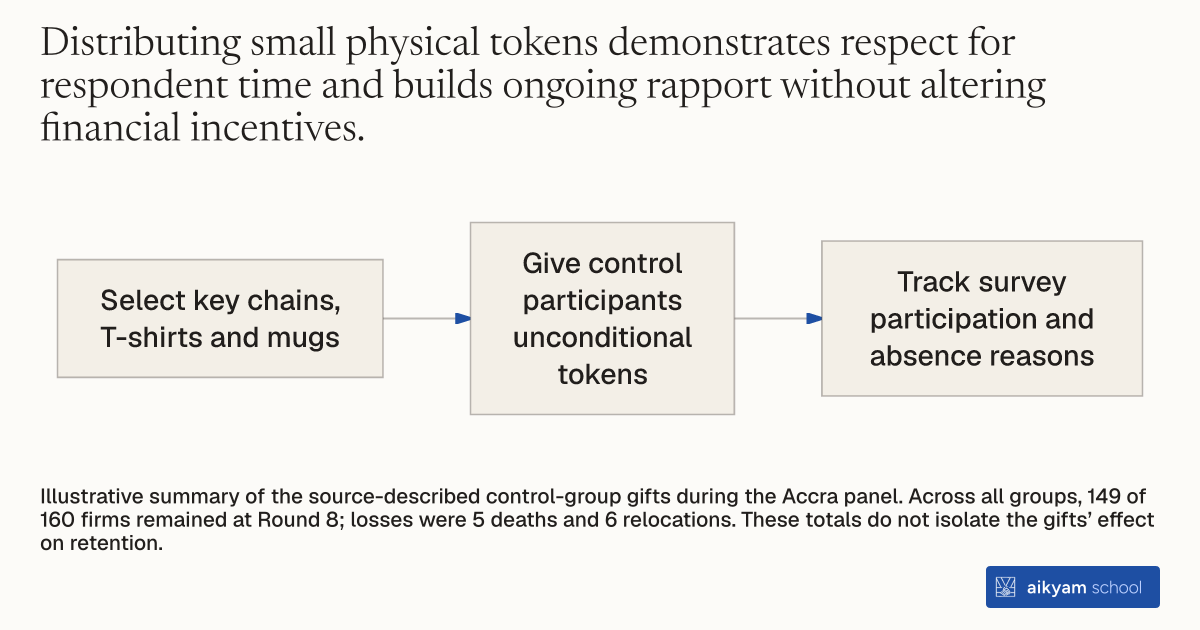
- Select key chains, T-shirts and mugs
- Give control participants unconditional tokens
- Track survey participation and absence reasons
Illustrative summary of the source-described control-group gifts during the Accra panel. Across all groups, 149 of 160 firms remained at Round 8; losses were 5 deaths and 6 relocations. These totals do not isolate the gifts’ effect on retention.
See source →How
When to use
In multi-round longitudinal panel studies, control group respondents frequently experience survey fatigue and drop out because they receive no direct intervention benefits. Distributing practical non-monetary items creates goodwill and maintains positive rapport across extended survey waves. This method serves research teams conducting multi-year surveys with informal microenterprises.
Distribute branded non-monetary items to control group participants during survey rounds to encourage ongoing research participation.
- Select low-cost household and business items such as key chains, t-shirts, and ceramic mugs.
- Transport the goodwill gift items to microenterprise shops during scheduled survey visits.
- Present the items to control group business owners alongside survey interviews as tokens of appreciation.
- Inform participants that the gifts carry no business performance obligations or conditional requirements.
- Track subject attendance and log reasons for any subject absence across all survey rounds.
Why it works
This non-monetary appreciation keeps control group members motivated to complete repeated survey questionnaires over time.
Example
Researchers provided key chains, t-shirts, and mugs to control group tailors in Accra, Ghana, to foster goodwill and encourage ongoing survey participation. The panel retained 149 of the original 160 microenterprises across eight survey rounds over two years, with overall attrition limited to 5 deaths and 6 relocations.
About the study
Participants
160 urban microenterprise tailors and seamstresses in Accra, Ghana.
Study Design
Longitudinal trial evaluation tracking 160 participants across 8 survey rounds over 24 months, using non-monetary tokens for control group retention.
Results
Non-monetary goodwill gifts helped retain 149 out of 160 participants (93% retention rate) through Round 8, with all 11 instances of attrition accounted for by 5 deaths and 6 permanent relocations, showing zero attrition correlated with treatment status.