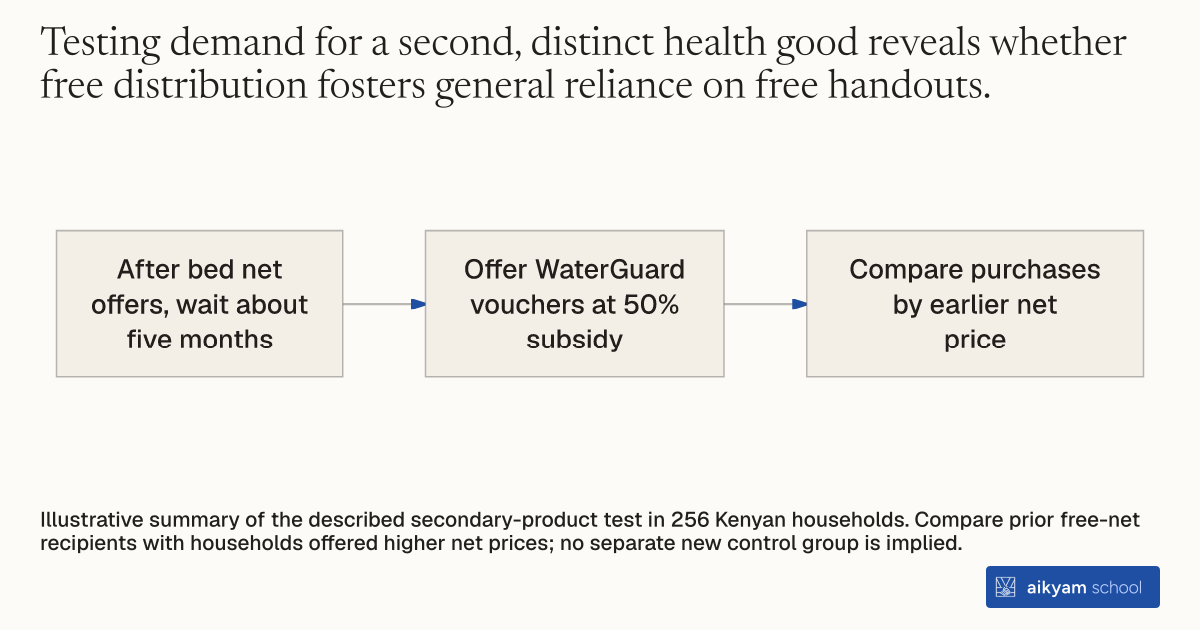
Research steps
Test demand for a second health product
- After bed net offers, wait about five months
- Offer WaterGuard vouchers at 50% subsidy
- Compare purchases by earlier net price
Illustrative summary of the described secondary-product test in 256 Kenyan households. Compare prior free-net recipients with households offered higher net prices; no separate new control group is implied.
See source →How
When to use
Health programs need to know if offering a free or heavily discounted health product creates a broad entitlement effect across other health items. Program planners worry that recipients of one free item will expect all subsequent health technologies to be free and refuse to buy them. Distributing vouchers for a distinct secondary health good at partial subsidies tests whether entitlement expectations spill over across product categories.
Distribute discount vouchers for a secondary health product to prior subsidy recipients to test for cross-product entitlement expectations.
- Identify households that previously received full or heavy subsidies for a primary health product.
- Select a distinct secondary health product from a similar preventive domain, such as point-of-use water purification.
- Issue discount vouchers for the secondary health product at a standard partial price subsidy approximately five months after the primary intervention.
- Set a designated redemption window and track voucher redemptions at local retail shops.
- Compare secondary product purchase rates between households that received free primary goods and those that paid higher primary prices.
Why it works
If purchase rates for the secondary good remain equal or higher among free primary product recipients, health programs can safely offer targeted subsidies without spoiling demand for other preventive products.
Example
In Western Kenya, researchers offered 50 percent subsidized WaterGuard vouchers to 256 households five months after distributing bed net vouchers; take-up of WaterGuard was 43.4 percent overall and slightly higher among recipients of free bed nets (43.4 percent vs 41.1 percent), showing no cross-product entitlement effect.
About the study
Participants
256 rural households across two enumeration areas in Busia District, Western Kenya.
Study Design
Sub-experiment distributing 50 percent subsidized vouchers for WaterGuard water disinfectant five months after Phase 1 bed net voucher distribution.
Results
WaterGuard purchase rates were 43.4 percent among recipients of free bed nets compared to 41.1 percent among non-high-subsidy recipients, demonstrating that receiving a free primary health product did not depress demand for secondary health goods.