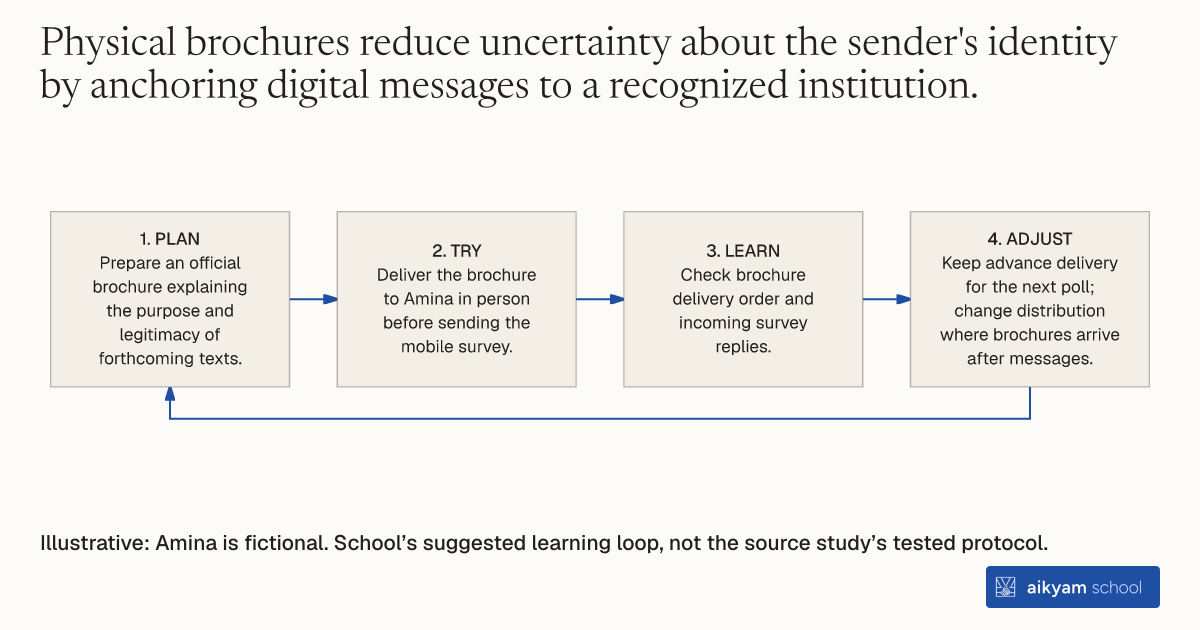
Try, learn and adjust
Check brochures arrive before mobile polls
- Plan: Prepare an official brochure explaining the purpose and legitimacy of forthcoming texts.
- Try: Deliver the brochure to Amina in person before sending the mobile survey.
- Learn: Check brochure delivery order and incoming survey replies.
- Adjust: Keep advance delivery for the next poll; change distribution where brochures arrive after messages.
Illustrative: Amina is fictional. School’s suggested learning loop, not the source study’s tested protocol.
See source →School’s suggested learning loop; not a tested source procedure. Observe brochure delivery before polling and logged responses; do not infer an individual trust outcome.
How
When to use
Mobile survey polls often receive low response rates because recipients doubt the identity and legitimacy of the sender. Unanchored digital messages create hesitation among smallholders asked to share farm details. Pre-distributing a printed official brochure establishes institutional credibility and increases engagement with subsequent mobile polls.
Distribute official printed information brochures to smallholder farmers before launching mobile SMS survey polls.
- Design an official printed brochure explaining the purpose and legitimacy of upcoming mobile survey messages.
- Field staff hand deliver the printed brochures to targeted smallholder sugarcane farmers in person.
- System administrators broadcast mobile survey questions to participating farmers via text message after brochure delivery.
- The system collects and logs incoming text responses from registered farmers.
Why it works
The printed document also creates a de-cluttering effect that draws farmer attention to mobile surveys.
Example
Innovations for Poverty Action and Mumias Sugar Company evaluated survey response rates across 57,615 SMS poll interactions with smallholder sugarcane farmers in Western Kenya. Delivering an official company brochure prior to messaging raised farmer response rates from a baseline of 7.0% up to 10.6%, representing a 3.6 percentage point increase.
About the study
Participants
57,615 SMS survey poll interactions sent to smallholder sugarcane farmers in Western Kenya.
Study Design
Randomized controlled survey trial comparing response rates when farmers received pre-distributed printed company brochures versus unanchored digital survey prompts.
Results
Delivering a company brochure increased survey response rates by 3.6 percentage points above the 7.0% basic group mean (a 51% relative increase, p < 0.01), capturing 64% of the response boost achieved by waiving text messaging costs entirely.