Try, learn and adjust
Check the official survey sender and replies
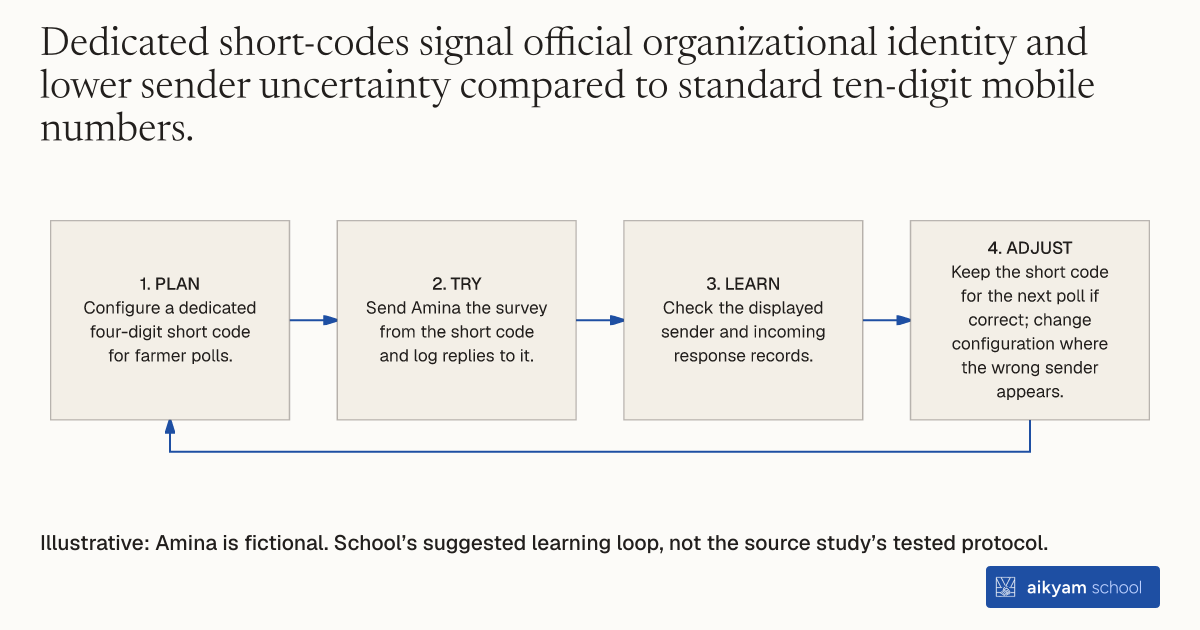
- Plan: Configure a dedicated four-digit short code for farmer polls.
- Try: Send Amina the survey from the short code and log replies to it.
- Learn: Check the displayed sender and incoming response records.
- Adjust: Keep the short code for the next poll if correct; change configuration where the wrong sender appears.
Illustrative: Amina is fictional. School’s suggested learning loop, not the source study’s tested protocol.
See source →School’s suggested learning loop; not a tested source procedure. Observe sender identity and replies. A sender check alone does not establish trust or improved participation.
How
When to use
Smallholder farmers frequently disregard text messages from unknown 10-digit mobile numbers due to spam or fraud concerns. Unverified sender identity lowers engagement in agricultural data collection and survey campaigns. Routing mobile communication through an official 4-digit short-code establishes sender authenticity and improves survey participation.
Route mobile survey polls through a dedicated four-digit short-code instead of standard ten-digit mobile numbers to signal legitimacy.
- Acquire an official dedicated four-digit short-code from local telecommunications providers.
- System administrators program the messaging platform to send mobile survey prompts exclusively through the dedicated short-code.
- System gateways transmit text messages displaying the official short-code to registered farmers.
- Program servers record and log incoming survey replies sent back to the short-code.
Why it works
Farmers associate standard phone numbers with less reliable sources, making them hesitant to reply or share personal farm details.
Example
Innovations for Poverty Action and Mumias Sugar Company evaluated survey response rates across 57,615 SMS poll interactions sent to smallholder sugarcane farmers in Western Kenya. Sending mobile survey queries from a standard ten-digit long code reduced farmer response rates by 2.1 percentage points compared to messages sent from a dedicated short-code.
About the study
Participants
57,615 SMS survey poll interactions sent to smallholder sugarcane farmers in Western Kenya.
Study Design
Randomized controlled survey trial comparing farmer response rates when survey polls originated from a dedicated 4-digit short-code versus a standard 10-digit long code.
Results
Sending SMS polls from a regular 10-digit long code lowered response rates by 2.1 percentage points relative to the dedicated short-code (p < 0.01), with the negative effect expanding to 3.5 percentage points when polls asked for confidential information.