Try, learn and adjust
Check village input fairs reach farmers before planting
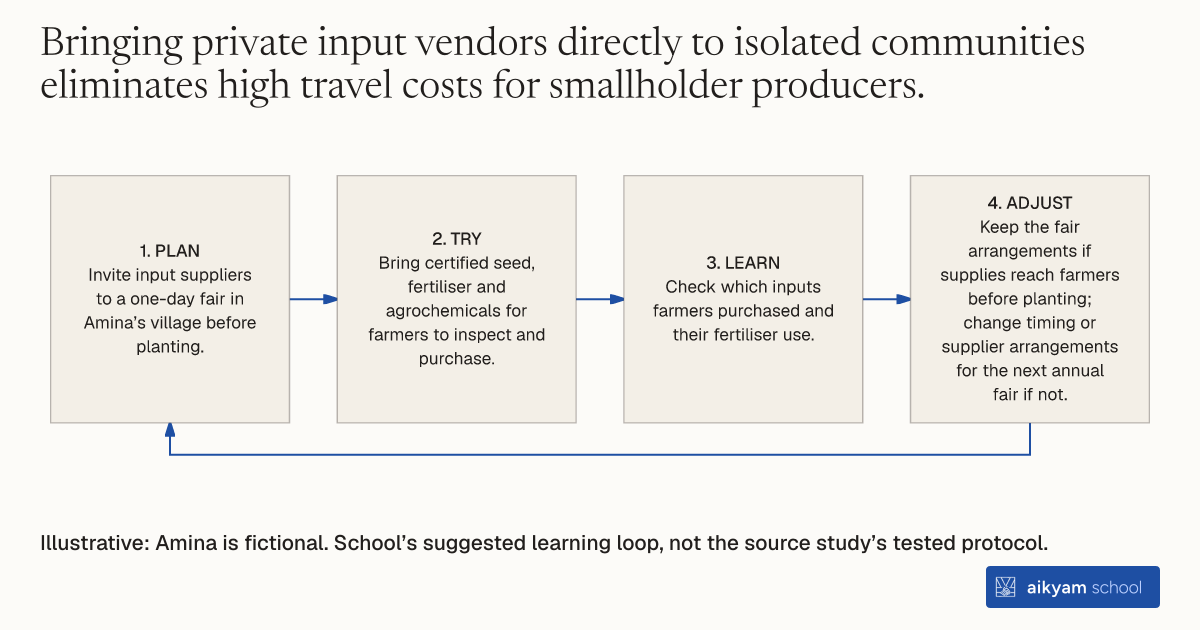
- Plan: Invite input suppliers to a one-day fair in Amina’s village before planting.
- Try: Bring certified seed, fertiliser and agrochemicals for farmers to inspect and purchase.
- Learn: Check which inputs farmers purchased and their fertiliser use.
- Adjust: Keep the fair arrangements if supplies reach farmers before planting; change timing or supplier arrangements for the next annual fair if not.
Illustrative: Amina is fictional. School’s suggested learning loop, not the source study’s tested protocol.
See source →Observe local input access, purchases and fertiliser use. School suggests this learning loop; it was not tested by the source.
How
When to use
Remote smallholder farmers frequently lack local input suppliers in their communities prior to planting seasons. Long transport distances and missing supply chains prevent farmers from purchasing certified seeds and fertilizer. Village input fairs bring private input merchants directly into underserved farming communities.
Organize temporary one-day village input fairs that bring commercial input suppliers directly to remote rural communities.
- Identify remote farming communities that lack local retail input suppliers prior to the planting season.
- Invite commercial input suppliers to bring certified seeds, fertilizers, and agro-chemicals to a centralized village location.
- Host a one-day market event in the village community before planting begins.
- Allow local smallholder farmers to inspect products and purchase agricultural inputs directly from visiting suppliers.
- Repeat input fair events annually ahead of major regional planting cycles.
Why it works
Direct vendor access allows farmers to buy essential supplies at the exact time needed for planting.
Example
In Mali, where most smallholder farmers lacked a local input supplier during the previous year, program organizers set up one-day village input fairs with visiting input merchants. Local farmers attended the fairs, purchased certified supplies, and expanded their overall fertilizer application.
About the study
Participants
Smallholder farmers in Mali where 70 percent lacked access to a local input supplier in the prior year.
Study Design
Randomized Evaluation (RCT).
Results
Providing one-day markets or village input fairs where suppliers visited communities increased farmers' purchase of inputs and fertilizer use.