Try, learn and adjust
Check capital and training are used together
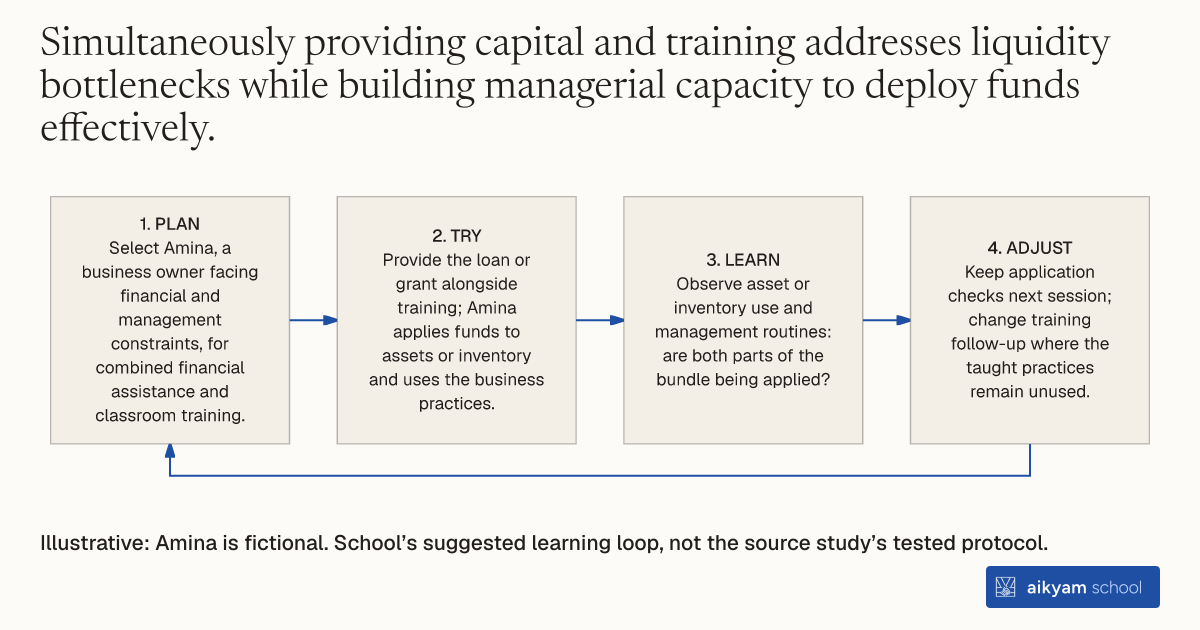
- Plan: Select Amina, a business owner facing financial and management constraints, for combined financial assistance and classroom training.
- Try: Provide the loan or grant alongside training; Amina applies funds to assets or inventory and uses the business practices.
- Learn: Observe asset or inventory use and management routines: are both parts of the bundle being applied?
- Adjust: Keep application checks next session; change training follow-up where the taught practices remain unused.
Illustrative: Amina is fictional. School’s suggested learning loop, not the source study’s tested protocol.
See source →School’s suggested, untested learning loop. Observe capital use and business practices; results for male entrepreneurs do not establish gains for female entrepreneurs.
How
When to use
Teaching business practices to microentrepreneurs may be insufficient if they face severe financial constraints. Combining loans or cash grants with classroom instruction seeks to resolve capital and human capital barriers simultaneously. This method supports microentrepreneurs who need both operating capital and management skills to expand their enterprises.
Provide microentrepreneurs with financial assistance combined with structured business skills training to relieve capital and knowledge barriers.
- Program administrators select microentrepreneurs who operate small enterprises with financial and managerial constraints.
- Lenders issue microcredit loans or cash grants directly to participating business owners.
- Trainers deliver traditional classroom business skills instruction alongside financial disbursement.
- Microentrepreneurs apply the capital toward purchasing business assets or inventory.
- Enterprise owners utilize newly learned business practices to manage the expanded capital stock.
Why it works
Relieving financial constraints allows microentrepreneurs to invest in inventory and equipment while using training concepts to manage higher sales volume.
Example
In Uganda, microentrepreneurs were offered loans of US\$180 to US\$220 alongside traditional classroom training, leading male entrepreneurs to report 54 percent higher profits.
About the study
Participants
Microentrepreneurs evaluated across seven studies testing simultaneous financial assistance and business training, including male and female microentrepreneurs in Uganda.
Study Design
Randomized controlled trials comparing combined cash grants or loans and business best practices training against control groups and single-component programs.
Results
Programs combining cash grants or loans with training increased short-run profits for some microentrepreneurs; in Uganda, male microentrepreneurs offered loans of US\$180-\$220 alongside classroom training reported 54 percent higher profits, while profits of female microentrepreneurs did not change.