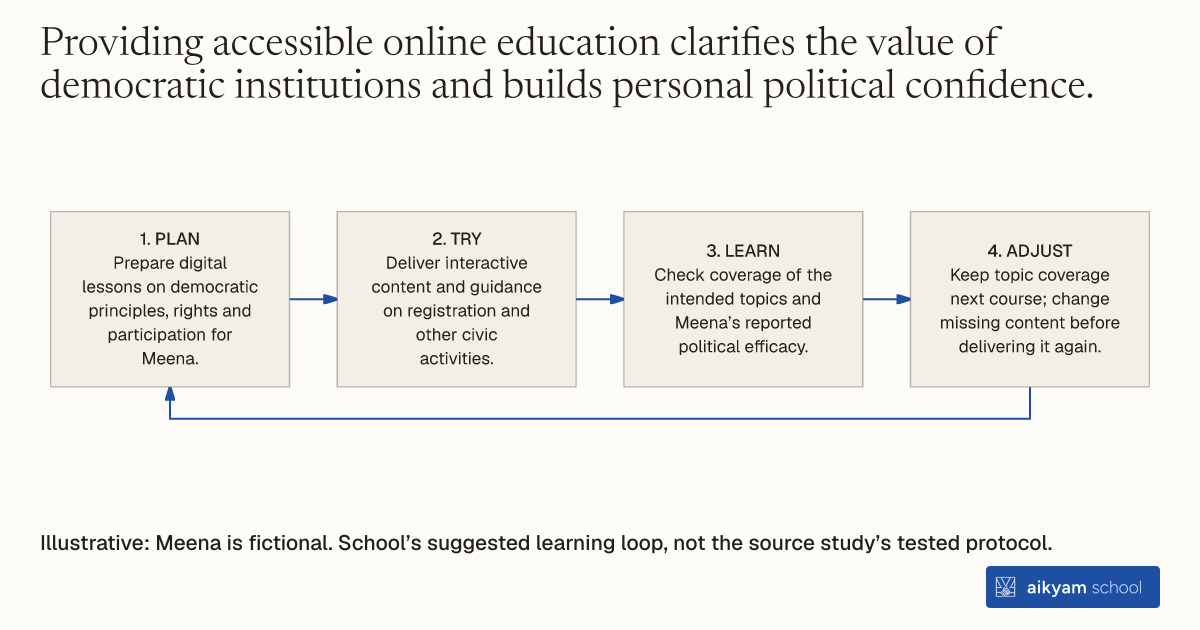
Try, learn and adjust
Check online civic education covers participation
- Plan: Prepare digital lessons on democratic principles, rights and participation for Meena.
- Try: Deliver interactive content and guidance on registration and other civic activities.
- Learn: Check coverage of the intended topics and Meena’s reported political efficacy.
- Adjust: Keep topic coverage next course; change missing content before delivering it again.
Illustrative: Meena is fictional. School’s suggested learning loop, not the source study’s tested protocol.
See source →Lesson coverage and reported efficacy; intentions are not observed participation. School’s suggested learning loop, not a source-tested cycle.
How
When to use
Citizens in new democracies experience disillusionment with democratic processes and nostalgia for authoritarian rule. Low political efficacy reduces citizens' intention to register and vote in elections. This method helps civic organizations deliver digital education to strengthen democratic commitment and political participation.
Deliver online civic education modules to citizens in new democracies to increase democratic values and political efficacy.
- Design digital educational modules focusing on democratic principles, citizen rights, and political participation.
- Publish and host civic education modules on accessible digital platforms.
- Recruit online participants across targeted demographics in transitioning democracies.
- Deliver interactive educational content that challenges authoritarian nostalgia and builds understanding of democratic institutions.
- Provide guidance encouraging citizens to register to vote and participate in non-electoral civic activities.
Why it works
This weakens nostalgia for authoritarian governance and motivates citizens to participate in civic life.
Example
In Tunisia, an online civic education program reduced participants' authoritarian nostalgia and increased their democratic values, political efficacy, and intentions to register and engage in political activities outside of voting.
About the study
Participants
Online participants and citizens across Tunisia.
Study Design
Field experiment evaluating an online civic education program in a new democracy.
Results
Reduced participants' authoritarian nostalgia and increased their democratic values, political efficacy, and intentions to register and engage in political activities outside of just voting.