Try, learn and adjust
Check household reach before newspaper delivery
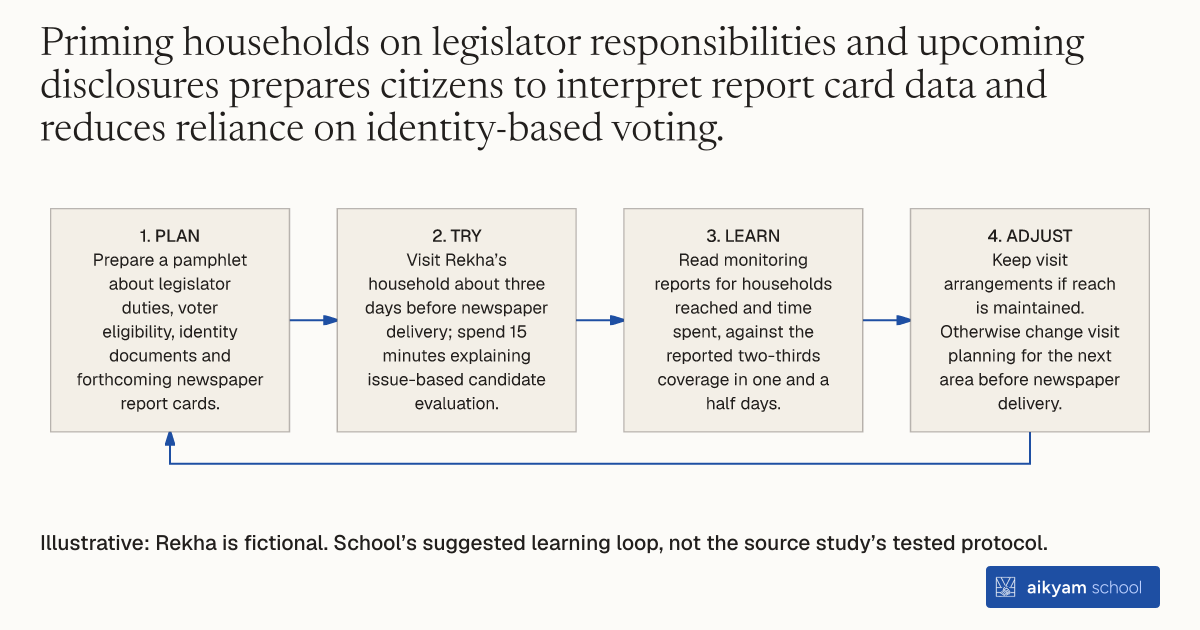
- Plan: Prepare a pamphlet about legislator duties, voter eligibility, identity documents and forthcoming newspaper report cards.
- Try: Visit Rekha’s household about three days before newspaper delivery; spend 15 minutes explaining issue-based candidate evaluation.
- Learn: Read monitoring reports for households reached and time spent, against the reported two-thirds coverage in one and a half days.
- Adjust: Keep visit arrangements if reach is maintained. Otherwise change visit planning for the next area before newspaper delivery.
Illustrative: Rekha is fictional. School’s suggested learning loop, not the source study’s tested protocol.
See source →Observe household reach and visit time. The trial evaluated pamphlets with newspapers, not this loop alone. School’s suggested learning loop; not a tested source procedure.
How
When to use
In low-income slum neighborhoods, voters often lack information on legislator duties and upcoming informational materials. Distributing door-to-door priming pamphlets prepares households to evaluate upcoming politician report cards. This prepares citizens in marginalized urban communities to process governance data before elections.
Inform and prime slum households about upcoming politician report cards through door-to-door pamphlet distribution before elections.
- NGO worker teams visit every household in targeted polling station slum neighborhoods roughly three days before newspaper delivery.
- Deliver a printed pamphlet informing residents that they will receive a free newspaper containing politician performance report cards.
- List legislator responsibilities in the pamphlet, including lawmaking, discretionary fund spending, and oversight committee membership.
- Detail voter eligibility requirements and accepted forms of identity proof needed on election day.
- Encourage households to use issue-based criteria rather than caste or religion to evaluate candidate performance.
- Spend 15 minutes per household, reaching two-thirds of households in each polling station within one and a half days.
Example
Two-member NGO teams visited households across 200 treatment slums in Delhi in November 2008, spending 15 minutes per household and reaching two-thirds of all slum households three days before newspaper delivery.
About the study
Participants
775 polling stations serving low-income slum households in 10 jurisdictions in Delhi, India, with average household income around 1 dollar a day per person.
Study Design
Randomized controlled trial comparing 200 treatment slums receiving priming pamphlets and newspapers against 575 control slums.
Results
Information dissemination using pamphlets and newspapers increased average voter turnout by 3.5 percent and reduced cash-based vote-buying by 19 percentage points.