Research procedure
Record real applicants’ job choices
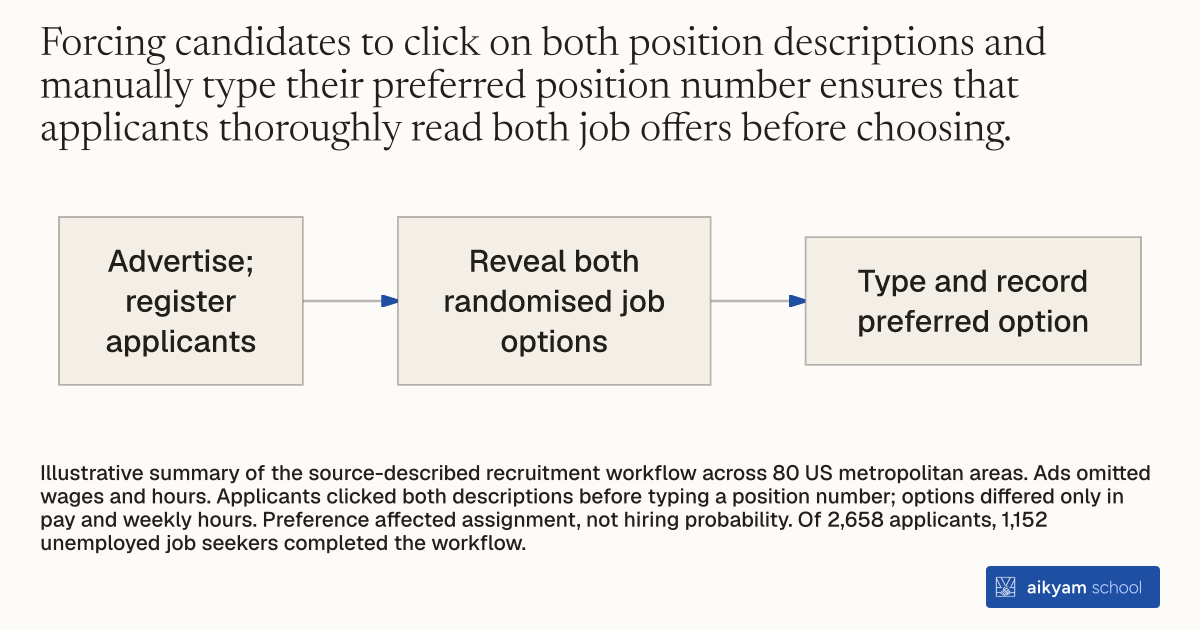
- Advertise; register applicants
- Reveal both randomised job options
- Type and record preferred option
Illustrative summary of the source-described recruitment workflow across 80 US metropolitan areas. Ads omitted wages and hours. Applicants clicked both descriptions before typing a position number; options differed only in pay and weekly hours. Preference affected assignment, not hiring probability. Of 2,658 applicants, 1,152 unemployed job seekers completed the workflow.
See source →How
When to use
Organizations seeking to recruit jobseekers across geographically dispersed areas while gathering unbiased preference choices must structure their recruitment process cleanly. This workflow addresses candidate selection and preference measurement for national phone survey or data entry positions. It enables employers to engage remote applicants while preventing presentation order biases.
Post job advertisements on national online job boards across target metropolitan areas and guide candidates through a standardized two-option selection workflow.
- Post advertisement listings on a major job board across 80 metropolitan areas without specifying hours or wages.
- Direct applicants to an external application portal where they register an account and report demographic details.
- Present candidates with two side-by-side job option descriptions that differ solely in weekly work hours and hourly pay rates.
- Require applicants to manually click on each job description to reveal position details before making a selection.
- Require applicants to manually type the preferred job position number into a choice box, ensuring choice sequence is randomized.
- Record applicant choices while reassuring candidates that their preference affects position assignment rather than hiring probability.
Why it works
Randomizing option presentation order eliminates order-bias effects while maintaining authentic applicant evaluation behavior.
Example
Researchers posted job ads on a national U.S. job platform across 80 large metropolitan areas for telephone interviewer and data entry positions. Interested applicants clicked an external link, created an account, viewed two randomized job descriptions differing in hours and wages, clicked each description, and typed their preferred position number to submit their application choice.
About the study
Participants
N = 2,658 total applicants (83% female, mean age 33.6 years, 45% White, 34% Black, 11% Hispanic) across 80 U.S. metropolitan areas.
Study Design
Field experiment embedded in a real-stakes recruitment process where applicants chose between two work-from-home position descriptions (X vs X+5 hours/week) with randomized pay rates.
Results
2,658 applicants entered the portal, with 1,152 unemployed jobseekers completing the choice workflow; effective wage randomization across hours choices showed balanced demographic distributions across treatments with no selective attrition.