Research procedure
Group participants at the nearest branch
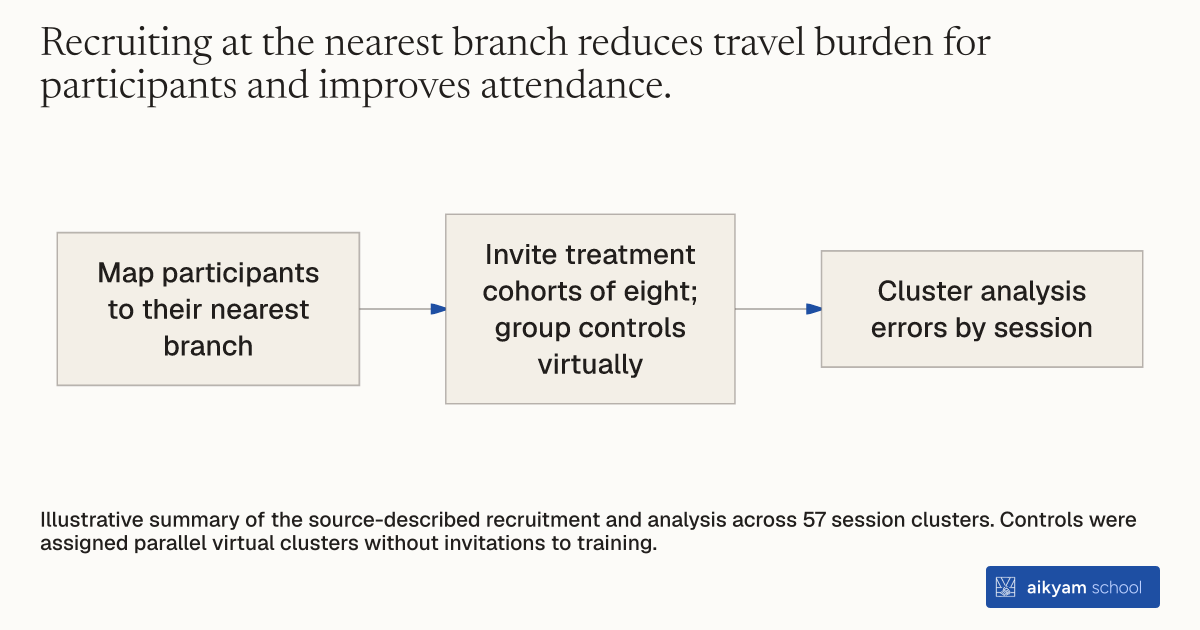
- Map participants to their nearest branch
- Invite treatment cohorts of eight; group controls virtually
- Cluster analysis errors by session
Illustrative summary of the source-described recruitment and analysis across 57 session clusters. Controls were assigned parallel virtual clusters without invitations to training.
See source →How
When to use
In field experiments involving group interventions, travel distance and peer interactions can distort attendance and statistical inference. Recruited participants may drop out if training locations are far away, while group sessions introduce within-cohort correlation. Assigning participants to small groups at their nearest facility and matching control subjects to parallel session clusters minimizes travel barriers and allows accurate standard error adjustments.
Recruit participants in small cohorts at their nearest local facility and assign control subjects to virtual clusters to permit session-level statistical error clustering.
- Map study participants to the geographical location of their nearest service branch.
- Form training cohorts of eight participants for each scheduled session at the nearest branch.
- Approach treatment group participants in their homes to invite them to a specific cohort session.
- Assign control group participants to equivalent virtual session clusters at their nearest branch without inviting them to attend.
- Cluster standard errors at the session level during statistical analysis to control for within-cohort peer interactions.
Why it works
Matching control subjects to parallel session clusters allows researchers to account for cohort-level intra-cluster correlation during analysis.
Example
In Ahmedabad, India, researchers recruited 289 female microfinance clients in home visits for cohorts of eight participants at their nearest SEWA Bank branch across 57 sessions, clustering control subjects similarly to adjust standard errors.
About the study
Participants
N = 636 randomized female microfinance clients (597 analyzed) across 57 training session clusters in Ahmedabad, India.
Study Design
Randomized Controlled Trial assigning treatment subjects to 8-person sessions at their nearest branch and assigning control subjects to parallel session clusters, with standard errors clustered at the session level.
Results
Nearest-branch recruitment achieved an overall program attendance rate exceeding 70% across 57 sessions, while session clustering controlled for intra-group social correlation during treatment impact estimation.