Try, learn and adjust
Check emissions permits cover plant output
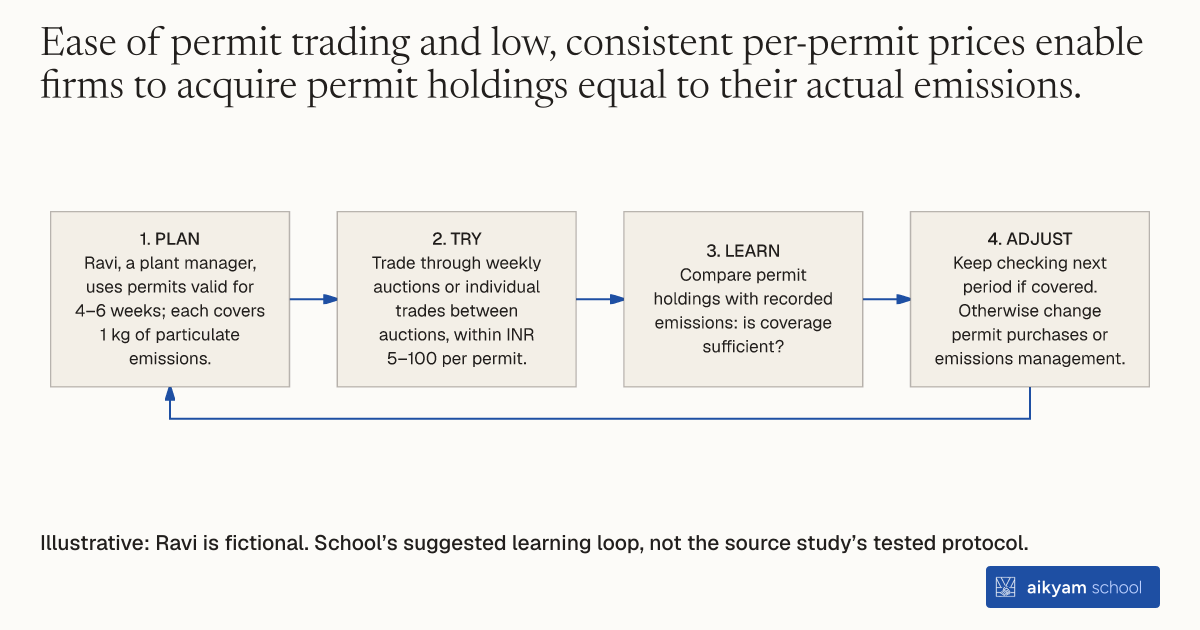
- Plan: Ravi, a plant manager, uses permits valid for 4–6 weeks; each covers 1 kg of particulate emissions.
- Try: Trade through weekly auctions or individual trades between auctions, within INR 5–100 per permit.
- Learn: Compare permit holdings with recorded emissions: is coverage sufficient?
- Adjust: Keep checking next period if covered. Otherwise change permit purchases or emissions management.
Illustrative: Ravi is fictional. School’s suggested learning loop, not the source study’s tested protocol.
See source →School’s suggested learning loop: observe permit validity, prices and emissions coverage; this loop is separate from the market design.
How
When to use
Environmental regulators in industrial cities need a low-friction mechanism to enable factories to trade emissions allowances without excessive price volatility or transaction costs. Without a structured electronic marketplace, facilities cannot easily buy or sell permits to match their actual emissions. Operating a bounded electronic platform allows industrial plants to trade pollution allowances at transparent, stable prices.
Facilitate emissions permit exchanges among industrial plants using weekly electronic auctions and bounded price bounds on a custom digital platform.
- Partner with a commodities exchange provider such as NCDEX e-Markets Limited to host a custom electronic trading platform.
- Issue digital permits valid for 4-to-6-week compliance periods where each permit allows 1 kg of particulate matter emissions.
- Establish floor and ceiling price collars between INR 5 and INR 100 per permit to maintain price stability.
- Conduct weekly electronic permit auctions on the platform allowing plant managers to trade permits with regulators or other firms.
- Permit individual bilateral transactions between weekly auctions on the digital platform.
Why it works
Smaller or lower-cost polluters sell excess permits to larger or higher-cost facilities, lowering total cost to abate pollution across the market.
Example
The Gujarat Pollution Control Board collaborated with NCDEX e-Markets Limited to operate a bounded electronic permit exchange for 156 textile factories in Surat, India across ten compliance periods between September 2019 and April 2021.
About the study
Participants
156 small and medium industrial textile plants assigned to the market intervention group in Surat, Gujarat, India.
Study Design
Randomized Controlled Trial evaluating electronic permit trading on the custom trading platform across ten compliance periods (4–6 weeks each) from September 2019 to April 2021.
Results
Operating the electronic permit platform enabled 156 market group firms to achieve near-perfect compliance and reduce particulate matter emissions by 20 to 30 percent compared to command-and-control comparison plants without increasing total abatement costs.