Try, learn and adjust
Check monitored emissions and permits are recorded
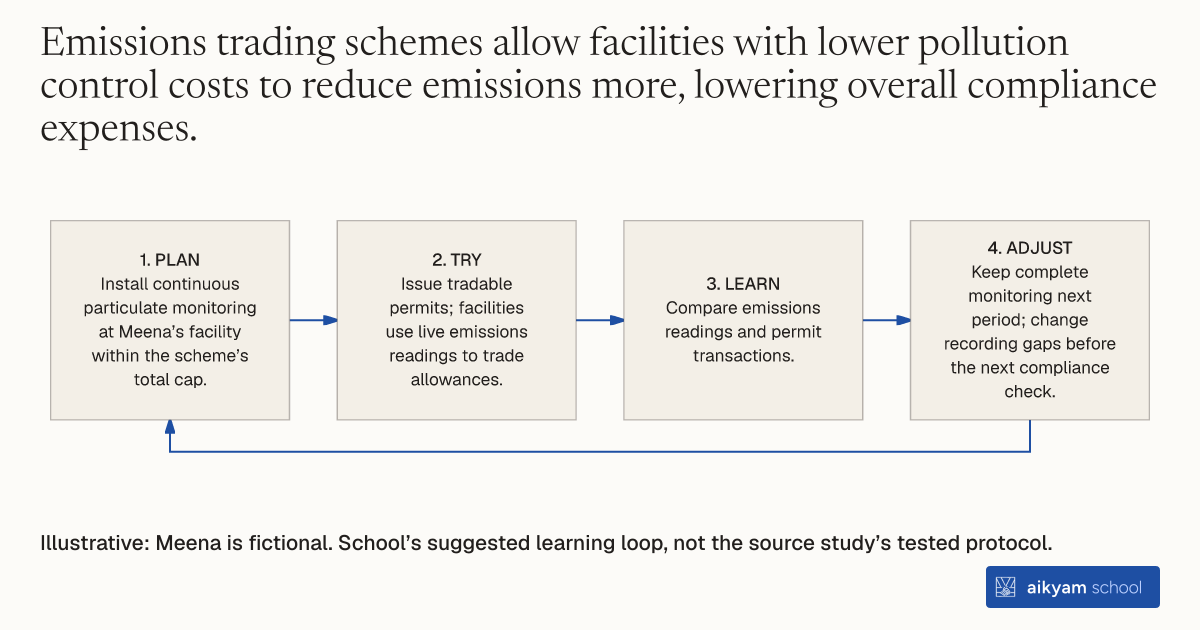
- Plan: Install continuous particulate monitoring at Meena’s facility within the scheme’s total cap.
- Try: Issue tradable permits; facilities use live emissions readings to trade allowances.
- Learn: Compare emissions readings and permit transactions.
- Adjust: Keep complete monitoring next period; change recording gaps before the next compliance check.
Illustrative: Meena is fictional. School’s suggested learning loop, not the source study’s tested protocol.
See source →Emissions readings and permit trades; do not assume each facility reduces emissions equally. School’s suggested learning loop, not a source-tested cycle.
How
When to use
Command-and-control environmental regulations that mandate strict emission limits for individual industrial facilities are difficult to enforce in settings with lower state capacity. These top-down rules impose high compliance costs on manufacturing plants. This method applies to environmental regulators seeking market-based mechanisms to lower industrial air pollution and cut abatement costs.
Implement a particulate emissions trading market integrated with continuous automated emissions monitoring devices.
- The environmental regulatory board installs continuous emissions monitoring systems devices across industrial manufacturing plants to transmit live particulate emissions data.
- The environmental regulatory board sets a total cap on allowable particulate air pollution across participating industrial facilities.
- The regulatory board issues tradable emissions permits corresponding to the cap to participating manufacturing plants.
- Industrial facilities monitor their live emissions readings and trade permits among each other based on their individual abatement costs.
- Plants that lower emissions below their assigned allowance sell surplus permits to facilities facing higher abatement expenses in Gujarat, India.
Why it works
Market-based mechanisms prove more enforceable than top-down command-and-control regulations in lower-capacity states.
Example
In Gujarat, India, state regulators collaborated with researchers to evaluate a particulate emissions trading scheme using continuous monitoring devices, where participating plants cut pollution emissions by 20 to 30 percent and reduced average abatement costs.
About the study
Participants
Industrial manufacturing plants in Gujarat, India.
Study Design
Randomized controlled trial evaluating an emissions trading scheme for particulate air pollution using continuous emissions monitoring systems devices.
Results
Industrial plants randomly assigned to participate in the scheme reduced pollution emissions by 20 to 30 percent and lowered average pollution abatement costs relative to command-and-control regulations.