Policy expansion
Trace emissions market expansion
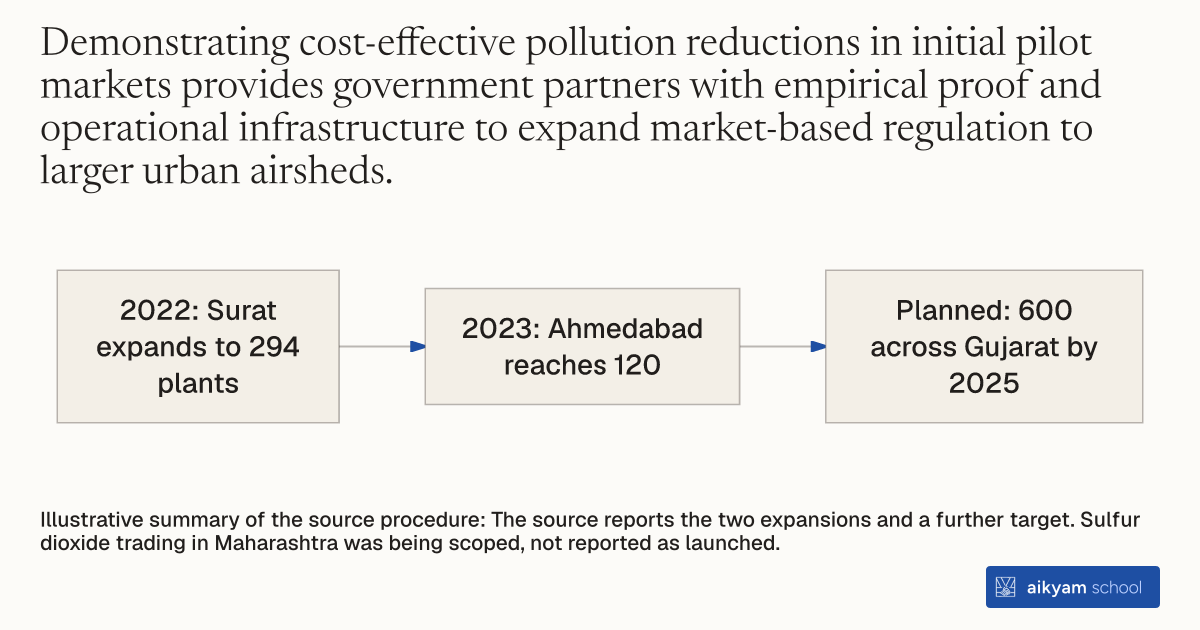
- 2022: Surat expands to 294 plants
- 2023: Ahmedabad reaches 120
- Planned: 600 across Gujarat by 2025
Illustrative summary of the source procedure: The source reports the two expansions and a further target. Sulfur dioxide trading in Maharashtra was being scoped, not reported as launched.
See source →How
When to use
Government authorities seeking to expand market-based pollution controls across multiple urban regions need a structured path to transition from single-city pilot programs to broad regional implementation. Isolated pilot markets leave nearby industrial clusters unaddressed and miss opportunities to reduce overall regional air pollution. Phased regional scaling replicates validated emissions trading frameworks across neighboring industrial hubs and additional target pollutants.
Replicate proven pilot emissions trading markets across major industrial urban centers and expand regulatory frameworks to additional target pollutants.
- Evaluate initial pilot market outcomes in the primary industrial cluster such as Surat to verify pollution reductions and firm compliance.
- Expand permit trading within the original pilot region to encompass additional industrial plants, scaling from 156 to 294 facilities in Surat.
- Replicate the trading framework in neighboring large industrial hubs, launching a second market reaching 120 facilities in Ahmedabad.
- Target further market expansion across the state to reach 600 industrial plants by 2025.
- Scope market expansion into adjacent state jurisdictions such as Maharashtra to target additional pollutants like sulfur dioxide.
Example
The Gujarat Pollution Control Board scaled the Surat emissions trading market to 294 textile plants in 2022, launched a second market reaching 120 industries in Ahmedabad in 2023, and planned expansion to 600 plants by 2025 alongside scoping sulfur dioxide trading in Maharashtra.
About the study
Participants
294 industrial plants in Surat (5.9 million population airshed) and 120 industrial plants in Ahmedabad (9.3 million population airshed), targeting up to 600 plants across Gujarat.
Study Design
Policy expansion and observational tracking following positive RCT evaluation results in Surat between 2022 and 2025.
Results
Scaling the Surat market reached 294 plants in an airshed of 5.9 million people, while the Ahmedabad launch reached 120 industries in an airshed of 9.3 million people, extending market-based pollution reduction across major urban populations.