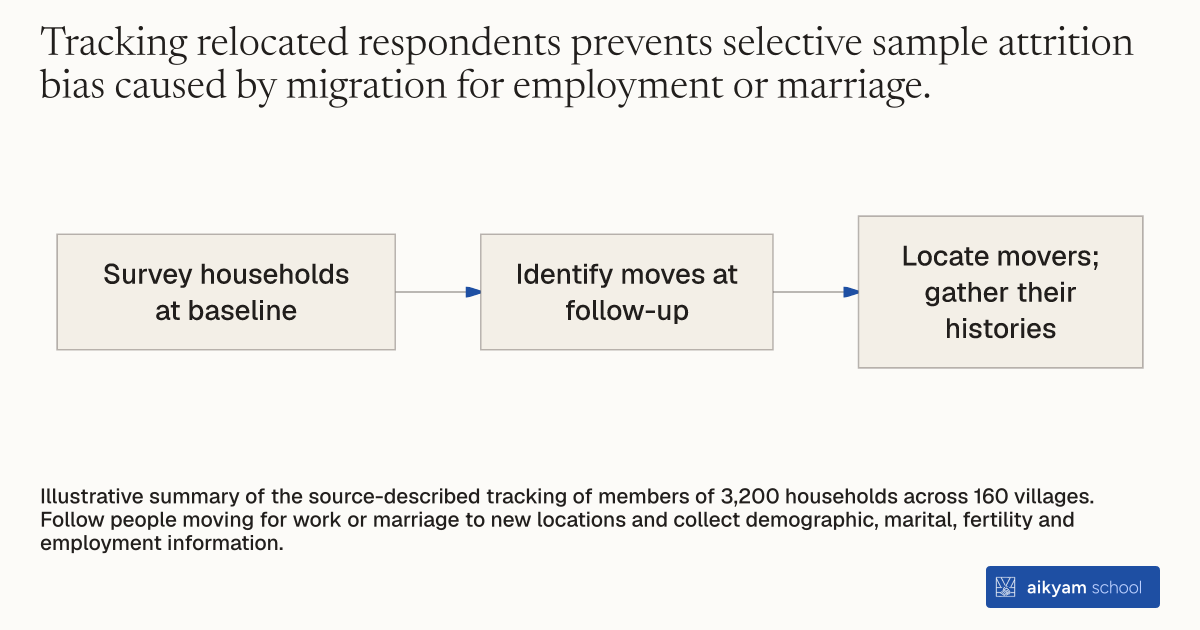
Research procedure
Follow respondents who move away
- Survey households at baseline
- Identify moves at follow-up
- Locate movers; gather their histories
Illustrative summary of the source-described tracking of members of 3,200 households across 160 villages. Follow people moving for work or marriage to new locations and collect demographic, marital, fertility and employment information.
See source →How
When to use
In longitudinal evaluations, sample attrition from individuals moving away for marriage or work can distort program impact estimates. This method systematically tracks migrated respondents across survey rounds. It helps researchers gather complete outcome data for mobile young rural adults.
Track and collect data on individuals who relocate between survey rounds to maintain complete sample follow-up.
- Surveyors conduct initial baseline surveys across 3,200 sample households in target rural villages.
- Surveyors return for follow-up survey rounds across a three-year intervention period.
- Surveyors identify family members who left home between survey rounds for work or marriage.
- Surveyors track relocated individuals to their new residential or employment locations.
- Surveyors gather demographic, marital, fertility, and employment information from the relocated respondents.
Why it works
Gathering complete data across rounds ensures accurate evaluation of program effects on mobile cohorts.
Example
Surveyors tracked 3,200 households across 160 rural villages in North India over three years, including individuals who moved away for BPO work or marriage. This tracking maintained full follow-up data, revealing a 4.6 percentage point increase in BPO employment and a 5 to 6 percentage point decrease in early marriage.
About the study
Participants
160 rural villages (80 treatment, 80 comparison) and 3,200 households across Haryana, Punjab, Rajasthan, and Uttar Pradesh, India.
Study Design
Longitudinal cluster randomized evaluation tracking household members who relocated between survey rounds over a three-year study period.
Results
Maintained complete follow-up data showing a 4.6 percentage point increase in BPO employment among women aged 18 to 24 and a 5 to 6 percentage point delay in marriage among women aged 15 to 21.