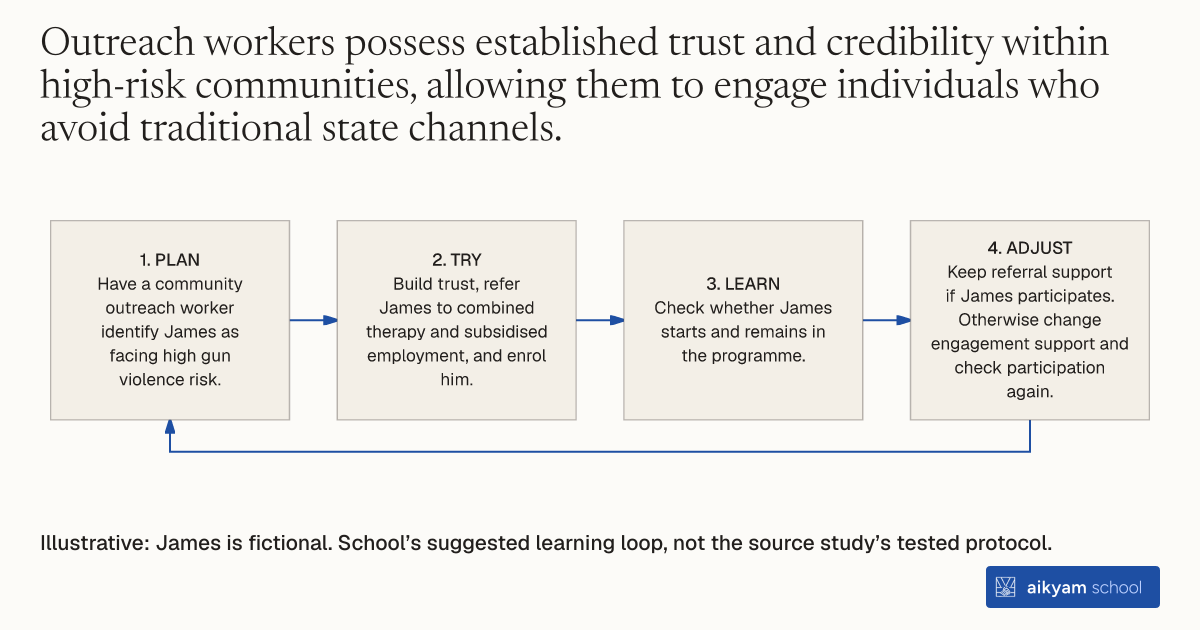
Try, learn and adjust
Check outreach referrals and programme participation
- Plan: Have a community outreach worker identify James as facing high gun violence risk.
- Try: Build trust, refer James to combined therapy and subsidised employment, and enrol him.
- Learn: Check whether James starts and remains in the programme.
- Adjust: Keep referral support if James participates. Otherwise change engagement support and check participation again.
Illustrative: James is fictional. School’s suggested learning loop, not the source study’s tested protocol.
See source →School’s suggested learning loop, not the source’s tested procedure. Observe programme take-up and retention. Source results for outreach referrals do not establish an isolated effect of referral alone.
How
When to use
Men at highest risk of gun violence are often disconnected and untrusting of state services and public institutions. Traditional recruitment methods fail to reach individuals who are most likely to be involved in serious street violence. Deploy community outreach workers to identify, refer, and recruit high-risk individuals into supportive behavioral and employment programs.
Deploy community outreach workers to identify and directly refer individuals at highest risk of gun violence into intervention programs.
- Outreach workers identify individuals in high-crime neighborhoods who face extreme risk of involvement in gun violence.
- Outreach workers build trust with potential participants who are disconnected from state institutions.
- Outreach workers refer and recruit identified individuals into combined behavioral therapy and subsidized employment programs.
- Program staff enroll referred individuals, achieving higher program take-up and retention compared to other referral channels.
Why it works
Direct referral by outreach workers increases initial program take-up and sustains longer-term participant retention.
Example
In Chicago, street outreach workers identified and referred men at highest risk of gun violence into the READI program. Referred participants achieved a 78 percent take-up rate, saw a 0.13 standard deviation reduction in serious violence, and experienced a 79 percent reduction in arrests for shooting and homicides.
About the study
Participants
Men at highest risk of involvement in gun violence in Chicago.
Study Design
Randomized controlled trial comparing outreach worker referrals and other referral mechanisms within an 18-month subsidized employment and CBT program against a control group.
Results
Outreach referrals achieved 78 percent program take-up, reduced involvement in serious violence by 0.13 standard deviations, reduced arrests for shooting and homicides by 79 percent, and reduced victimizations by 43 percent.