Try, learn and adjust
Check recruitment against baseline risk
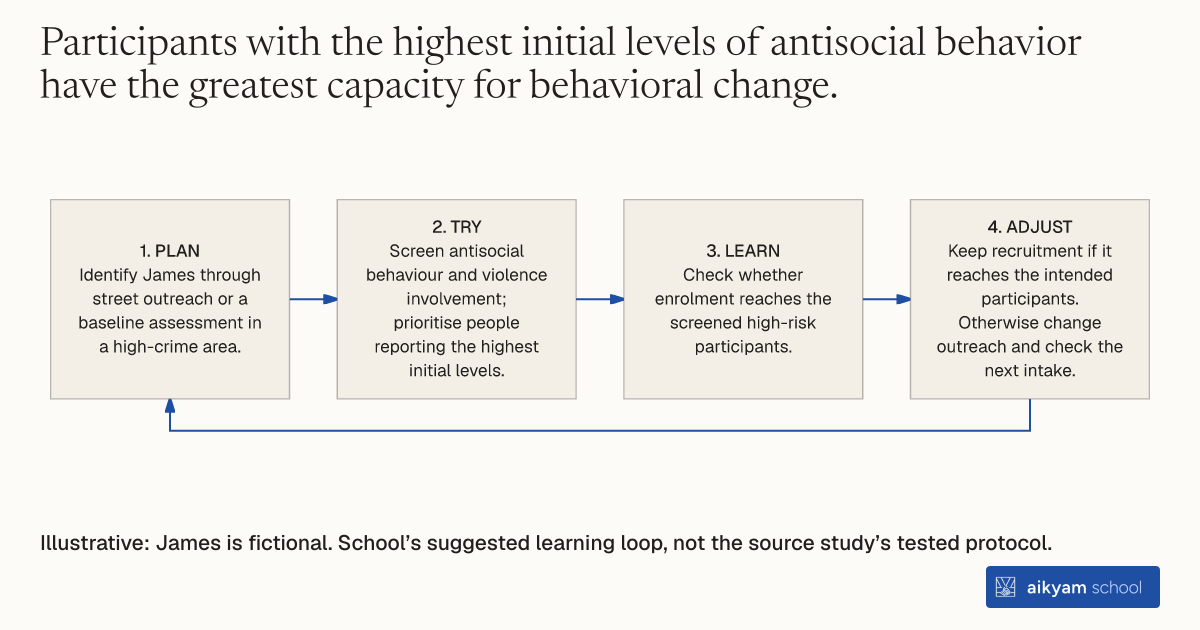
- Plan: Identify James through street outreach or a baseline assessment in a high-crime area.
- Try: Screen antisocial behaviour and violence involvement; prioritise people reporting the highest initial levels.
- Learn: Check whether enrolment reaches the screened high-risk participants.
- Adjust: Keep recruitment if it reaches the intended participants. Otherwise change outreach and check the next intake.
Illustrative: James is fictional. School’s suggested learning loop, not the source study’s tested protocol.
See source →School’s suggested learning loop, not the source’s tested procedure. Observe baseline screening and enrolment. This check does not establish a treatment effect.
How
When to use
Behavior change programs aim to reduce crime and violence across high-risk groups. Interventions often achieve the largest impact when delivered to individuals with the highest baseline levels of misbehavior. Screen and target the most antisocial participants to maximize program effectiveness and societal benefits.
Target interventions directly to individuals exhibiting the highest baseline levels of antisocial behavior and violence risk.
- Identify high-risk individuals in high-crime areas through street outreach workers or baseline assessments.
- Screen potential participants to measure baseline levels of antisocial behavior and violence involvement.
- Prioritize enrollment for participants who report the highest initial levels of misbehavior.
- Concentrate program resources on this high-risk population to engage individuals who are typically disconnected from services.
Why it works
Concentrating resources on high-risk individuals prevents a disproportionate share of societal violence and crime.
Example
In Liberia, implementers measured baseline antisocial behavior among high-risk men prior to a CBT intervention. For the most antisocial group, therapy alone reduced antisocial behavior by 0.91 standard deviations, and therapy with cash reduced it by 1.25 standard deviations.
About the study
Participants
High-risk men in Monrovia, Liberia and 2,500 high-risk men in Chicago.
Study Design
Randomized controlled trials evaluating targeted behavioral interventions and cash or employment programs against comparison groups.
Results
In Liberia, therapy alone reduced antisocial behavior by 0.91 standard deviations and therapy plus cash by 1.25 standard deviations among the most antisocial men; in Chicago, targeting less than 0.01 percent of the population reached men accounting for 6 percent of shooting and homicide victims.