Try, learn and adjust
Check ownership history before title approval
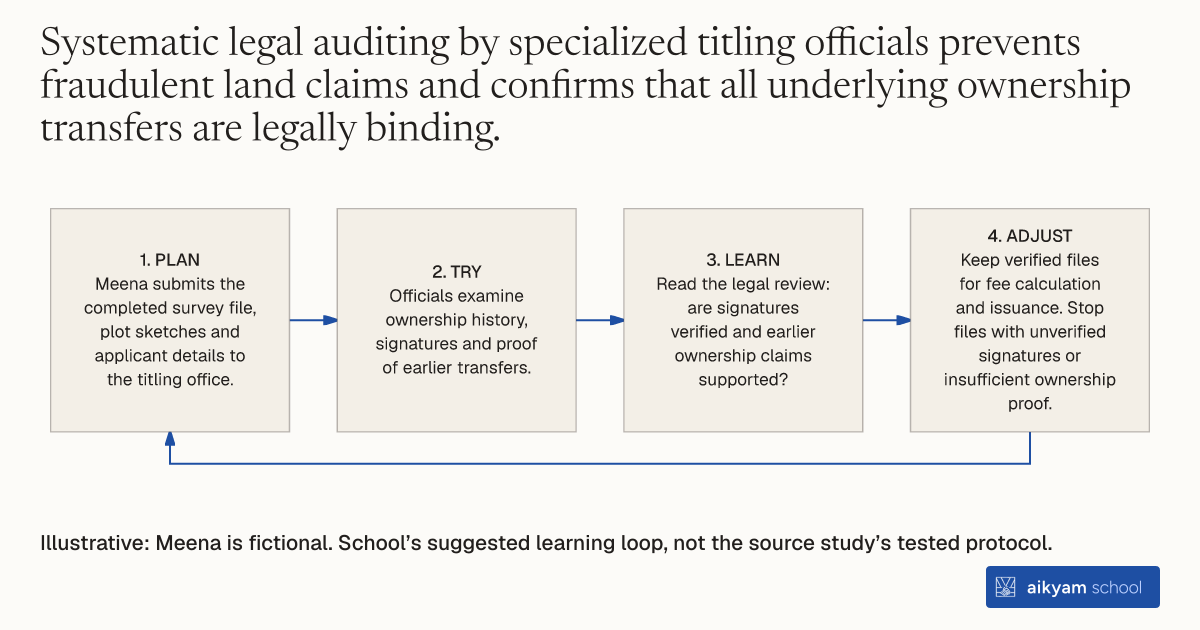
- Plan: Meena submits the completed survey file, plot sketches and applicant details to the titling office.
- Try: Officials examine ownership history, signatures and proof of earlier transfers.
- Learn: Read the legal review: are signatures verified and earlier ownership claims supported?
- Adjust: Keep verified files for fee calculation and issuance. Stop files with unverified signatures or insufficient ownership proof.
Illustrative: Meena is fictional. School’s suggested learning loop, not the source study’s tested protocol.
See source →School’s suggested learning loop checks legal verification, separately from the described title review.
How
When to use
Before issuing a new formal land title, land administration authorities must verify that an applicant holds legitimate legal claims to the property. Historical land transfers often rely on outdated, informal, or incomplete documentation that creates legal vulnerabilities and land disputes. Government land titling offices conduct legal reviews and ownership audits to verify past purchase records and document signatures before approving title conversion.
Review historical land documentation and verify ownership claims through a systematic legal audit at the government land titling office.
- Submit the completed cadastral file containing intermediate survey documents, plot sketches, and applicant details to the land titling office as detailed in Section 4.4.
- Examine the full ownership history of the target plot to determine whether the land satisfies legal eligibility requirements for the requested title type.
- Verify the authenticity of signatures on existing property contracts and historical transfer documents.
- Check whether former occupants provided sufficient legal proof of ownership for previous land transfers.
- Reject files that contain unverified signatures or insufficient proof of historical ownership, or approve verified files for fee calculation and title issuance.
Why it works
This ensures that newly issued titles hold unassailable legal authority under state law.
Example
Officials at the land titling office in Kananga, DRC, audited ownership histories and verified document signatures for 483 eligible land titling applicants before authorizing payment receipts and final title issuance.
About the study
Participants
4,343 randomly sampled households across 364 neighborhoods in Kananga, Democratic Republic of Congo, with 483 eligible households in the main analysis sample.
Study Design
Randomized controlled trial evaluating a subsidized land titling program where treated applicants progressed through technical cadastral processing and title legal review.
Results
Program assignment caused a 44 percentage point increase in initiation of the land titling process and a 13.7 percentage point increase in actual receipt of formal land titles.