Research procedure
Verify land-title take-up
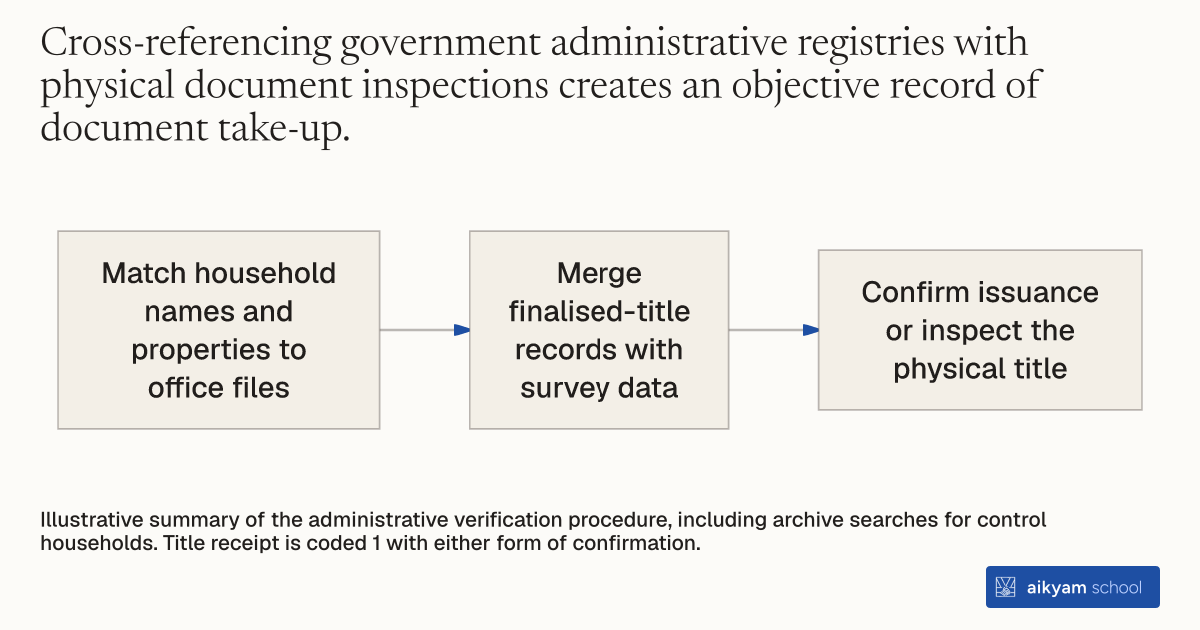
- Match household names and properties to office files
- Merge finalised-title records with survey data
- Confirm issuance or inspect the physical title
Illustrative summary of the administrative verification procedure, including archive searches for control households. Title receipt is coded 1 with either form of confirmation.
See source →How
When to use
In program evaluation, relying solely on participant self-reports to confirm document acquisition can introduce recall errors or reporting bias. Evaluators need an objective administrative verification method to determine whether program participants opened official files and completed legal formalization. Survey teams obtain official government land registries and cross-verify registry files against survey rosters and physical documents.
Verify program participation and legal document receipt by matching household survey rosters against official administrative records from government land offices.
- Obtain official administrative files and registration logs from provincial cadastral and land titling offices as described in Section 5.
- Cross-check the names and property details of survey respondents against administrative land records to record whether a file was opened.
- Search government land titling archives using respondent rosters to verify file initiation for control group participants who did not receive program home visits.
- Merge government administrative records of newly finalized titles with household survey datasets.
- Code title receipt as 1 if government records confirm issuance or if a respondent shows the physical title document to an enumerator during follow-up visits.
Why it works
This eliminates self-reporting bias and ensures precise tracking of legal formalization outcomes across treatment and control groups.
Example
Researchers matched survey rosters of 483 eligible households in Kananga, DRC, against provincial cadastral and titling office registries, confirming that titling initiation rose by 44 percentage points and title receipt increased by 13.7 percentage points.
About the study
Participants
4,343 randomly sampled households across 364 neighborhoods in Kananga, Democratic Republic of Congo, with 483 eligible households in the main analysis sample.
Study Design
Merging official land registry administrative data with household survey rosters and physical document verification to evaluate take-up in a randomized land titling field experiment.
Results
Program assignment caused a 44 percentage point increase in initiation of the land titling process and a 13.7 percentage point increase in actual receipt of formal land titles.