Try, learn and adjust
Check access to weekly workplace training
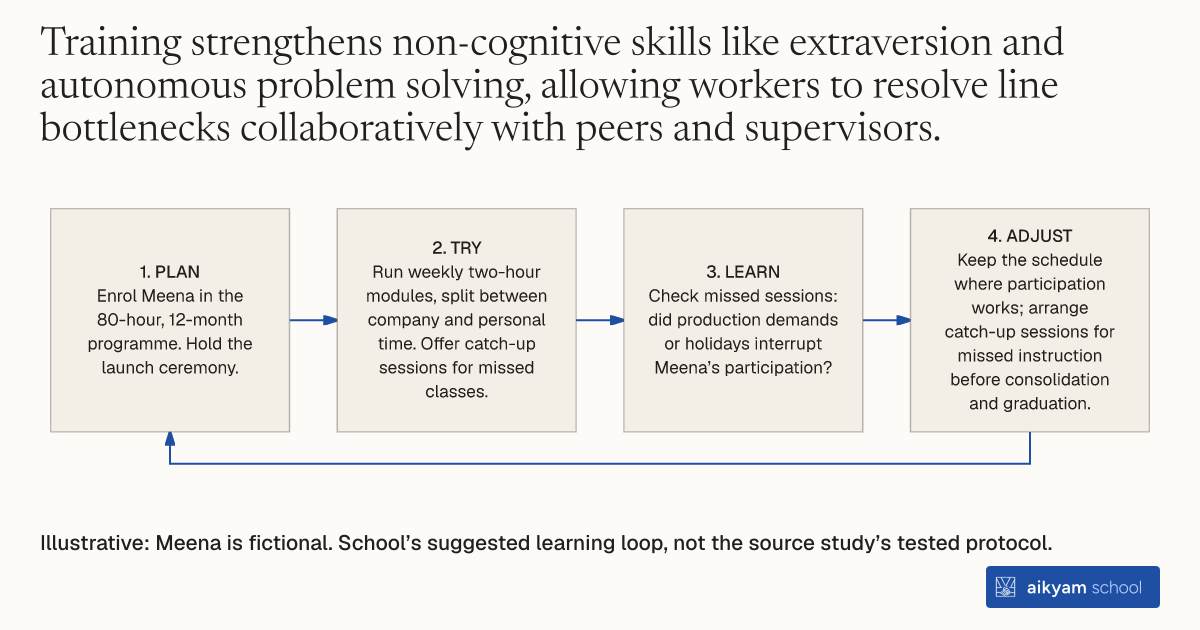
- Plan: Enrol Meena in the 80-hour, 12-month programme. Hold the launch ceremony.
- Try: Run weekly two-hour modules, split between company and personal time. Offer catch-up sessions for missed classes.
- Learn: Check missed sessions: did production demands or holidays interrupt Meena’s participation?
- Adjust: Keep the schedule where participation works; arrange catch-up sessions for missed instruction before consolidation and graduation.
Illustrative: Meena is fictional. School’s suggested learning loop, not the source study’s tested protocol.
See source →School’s suggested learning loop, not a tested protocol. Observe missed classes and catch-up delivery. Draw no more than 3 to 4 workers from a line per session.
How
When to use
Low-wage frontline workers often lack key life skills like effective communication, goal setting, and problem solving. This deficit lowers daily team productivity and limits individual career progression in manufacturing settings. Deliver structured workplace soft skills modules to female garment workers to improve operational coordination and individual performance.
Deliver eighty hours of workplace life skills instruction to enrolled female factory workers over twelve months using two-hour weekly classroom modules split between company time and employee personal time.
- Hold an introductory launch ceremony to align participants, trainers, and factory managers on program goals.
- Teach core modules covering communication for nine point five hours, problem solving and decision making for thirteen hours, and time and stress management for twelve hours.
- Deliver complementary modules covering execution excellence for five hours, financial literacy for four point five hours, legal literacy for eight point five hours, water, sanitation, and hygiene for six hours, and health for ten hours.
- Schedule interactive classroom sessions for two hours each week at the start of the production day, drawing no more than three to four workers from any single line per session.
- Provide catch-up sessions for workers who miss scheduled weekly meetings due to production demands or holidays.
- Conduct two consolidation review sessions totaling three hours to reinforce concepts and discuss personal applications.
- Conclude the twelve-month curriculum with a formal graduation ceremony to celebrate program completion.
Why it works
Increased communication efficiency enables workers to handle complex tasks without losing speed.
Example
A ready-made garment export firm enrolled 1,087 female sewing machine operators across five factories in Bengaluru, India in the P.A.C.E. program. Participating workers attended weekly two-hour training sessions over twelve months while maintaining regular factory assignments. Program completion increased worker production efficiency by 10.8 percentage points and generated a 258 percent net financial return for the firm eight months after training ended.
About the study
Participants
2,703 female garment workers across 112 production lines in 5 export garment factories in Bengaluru, India.
Study Design
Two-stage randomized controlled trial with line-level randomization into treatment or control followed by worker-level lottery selection on treatment lines, measuring daily tablet production data and administrative payroll over 20 months.
Results
Trained workers increased production efficiency by 10.8 percentage points (a 20 percent increase over the control mean of 54.2 percent, p < 0.05) and task complexity by 0.0384 standard allowable minutes (p < 0.05), while monthly wages rose by 0.5 percent (0.492 percent, p < 0.10) with no change in long-run turnover, yielding a 258 percent net return on investment to the firm 8 months post-program.