Research steps
Compare module knowledge scores
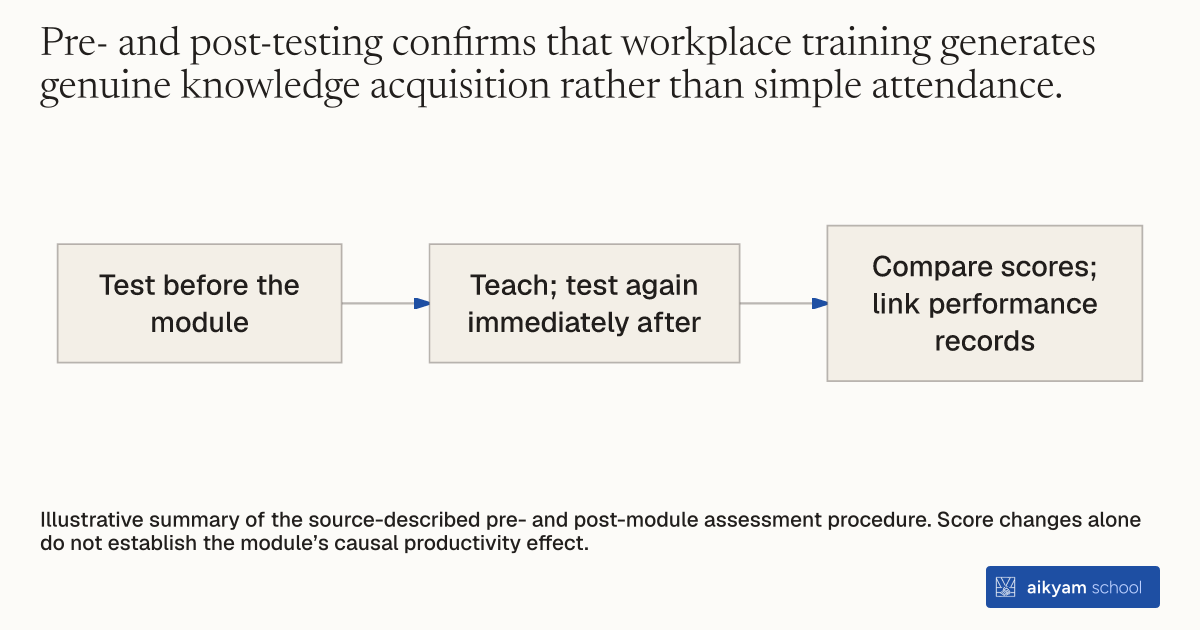
- Test before the module
- Teach; test again immediately after
- Compare scores; link performance records
Illustrative summary of the source-described pre- and post-module assessment procedure. Score changes alone do not establish the module’s causal productivity effect.
See source →How
When to use
Evaluating workplace training programs without testing knowledge acquisition makes it difficult to determine whether performance changes stem from actual skill learning. Unmeasured learning outcomes prevent managers from identifying which specific curriculum modules were successfully absorbed. Administer standardized pre- and post-module assessments to frontline trainees to measure topic-specific knowledge accumulation.
Administer standardized pre- and post-module written test instruments before and immediately after each training topic to evaluate worker knowledge absorption.
- Administer a baseline written test instrument to enrolled workers immediately prior to starting each curriculum module.
- Deliver the module instruction, practical exercises, and group discussions over scheduled weekly classroom hours.
- Administer a matching post-module written test instrument to participants upon concluding each module's instructional hours.
- Score assessment instruments across core topics including communication, problem solving, time management, financial literacy, and execution excellence.
- Plot baseline and endline test score distributions to compare score increases across specific instructional modules.
- Link individual assessment score improvements to daily workplace performance records to evaluate the impact of skill acquisition on productivity.
Why it works
Comparing module test score distributions validates that instructional content was successfully absorbed before evaluating long-run performance impacts.
Example
Trainers across 5 garment export factories in Bengaluru, India administered pre- and post-module tests developed by Gap Inc. to female garment workers during the P.A.C.E. program. Participants scored significantly higher on post-module tests across every module, achieving score increases ranging between 85 percent and 110 percent above pre-module baseline scores.
About the study
Participants
2,703 female garment workers across 112 production lines in 5 export factories in Bengaluru, India.
Study Design
Two-stage randomized controlled trial using trainer-administered pre- and post-module test score distributions developed by Gap Inc. across all P.A.C.E. instructional modules.
Results
Post-module test scores increased by approximately 85 percent to 110 percent relative to pre-module baseline scores across all training modules, confirming robust skill and knowledge acquisition.