Try, learn and adjust
Check career readiness support
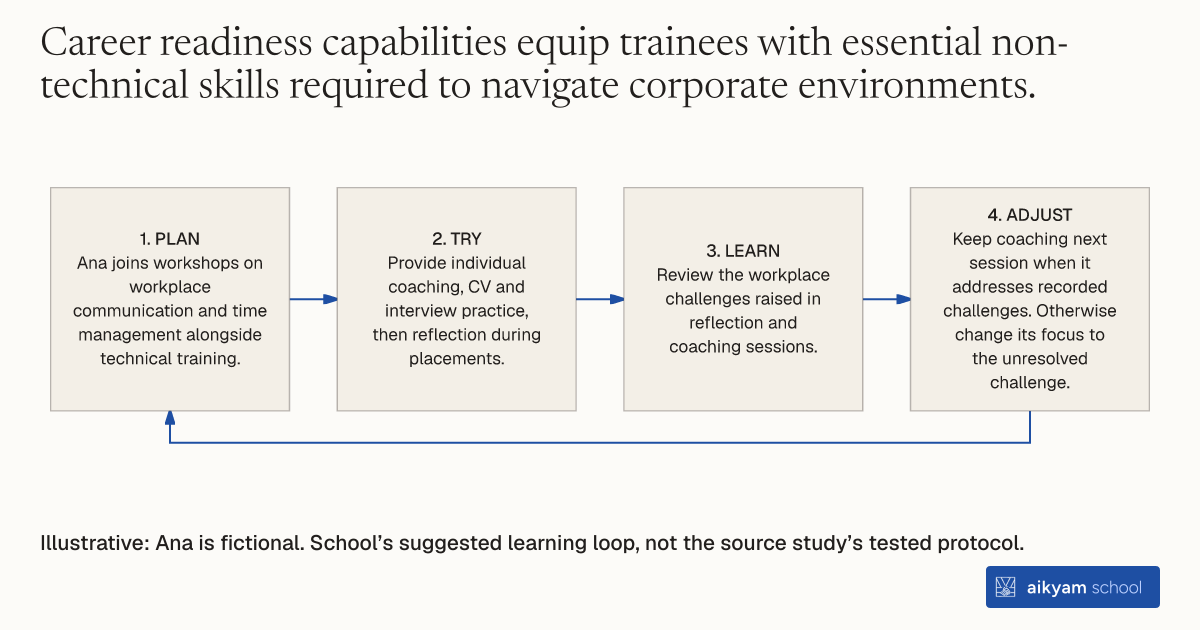
- Plan: Ana joins workshops on workplace communication and time management alongside technical training.
- Try: Provide individual coaching, CV and interview practice, then reflection during placements.
- Learn: Review the workplace challenges raised in reflection and coaching sessions.
- Adjust: Keep coaching next session when it addresses recorded challenges. Otherwise change its focus to the unresolved challenge.
Illustrative: Ana is fictional. School’s suggested learning loop, not the source study’s tested protocol.
See source →School’s suggested, untested learning loop. Observe workplace challenges and coaching follow-ups; the evaluations tested training packages, not this loop alone.
How
When to use
Non-college job seekers often struggle during hiring interviews and early job placements due to a lack of professional workplace familiarity. Technical competencies alone cannot guarantee job retention if workers experience workplace communication barriers or interpersonal conflict. Program staff solve this problem by incorporating non-technical career readiness training alongside occupational instruction.
Deliver structured instruction in general life skills and professional workplace expectations alongside technical training.
- Schedule mandatory workshops covering professional communication, time management, study skills, critical thinking, and conflict resolution.
- Conduct one-on-one pre-employment coaching sessions during technical training courses.
- Lead resume development and mock interview preparation workshops to build job search readiness.
- Organize weekly reflection sessions during work placements or internships to discuss workplace challenges.
- Provide ongoing coaching follow-ups via email or in person up to three times per week during job searches.
Why it works
Teaching problem-solving and professional communication helps workers overcome workplace friction and maintain long-term employment.
Example
Project QUEST in San Antonio held weekly meetings focusing on life skills like time management, study skills, critical thinking, and conflict resolution.
About the study
Participants
Human urban youth aged 18 to 24 participating in YearUp national cohorts across US metropolitan sites.
Study Design
Randomized Controlled Trial (RCT) evaluated by Fein et al. (2018, 2021) measuring earnings, hours, and wages at 3-year and 5-year follow-ups.
Results
YearUp participants receiving career readiness instruction alongside technical training earned \$7,011 more (a 40 percent increase, p < 0.01) in Year 3 and worked an average of 3.4 more hours per week (a 13.9 percent increase).