Try, learn and adjust
Check regular paid work delivery
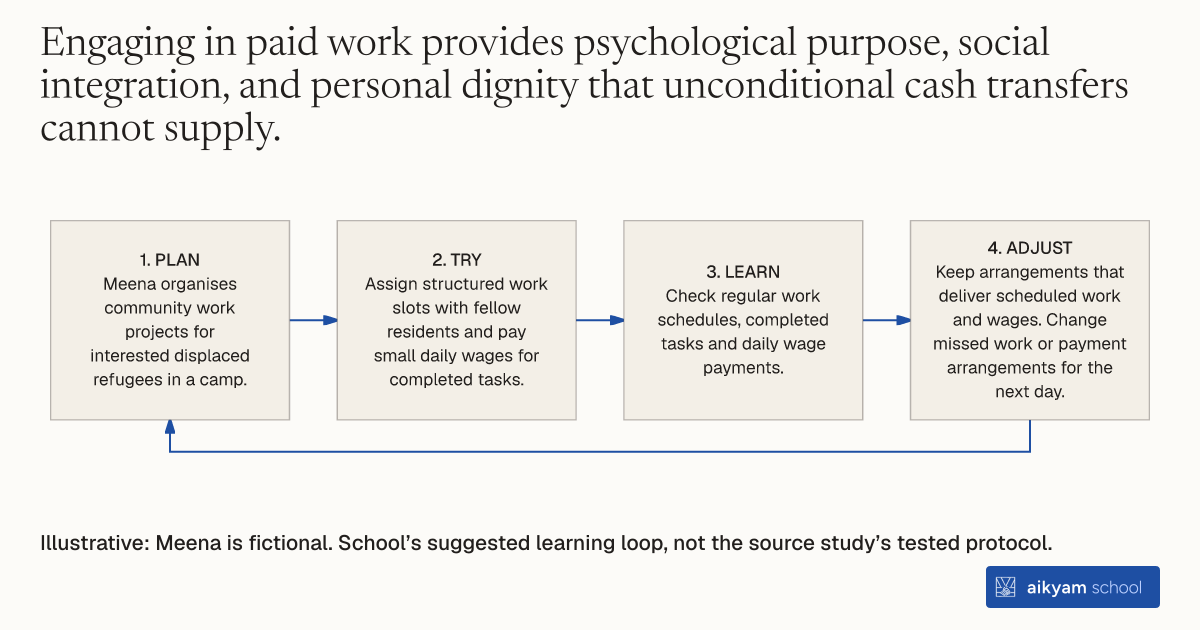
- Plan: Meena organises community work projects for interested displaced refugees in a camp.
- Try: Assign structured work slots with fellow residents and pay small daily wages for completed tasks.
- Learn: Check regular work schedules, completed tasks and daily wage payments.
- Adjust: Keep arrangements that deliver scheduled work and wages. Change missed work or payment arrangements for the next day.
Illustrative: Meena is fictional. School’s suggested learning loop, not the source study’s tested protocol.
See source →School’s suggested learning loop checks work and pay delivery, separately from the study’s comparison of paid work with equal cash without work.
How
When to use
Address psychological distress, social isolation, and loss of purpose among displaced refugees living in camps. Provide meaningful structured daily employment rather than unconditional cash aid alone. Support mental health and economic well-being for vulnerable refugee populations.
Provide temporary paid work opportunities in place of unconditional cash transfers to refugees in camp environments.
- Identify displaced refugee populations experiencing high unemployment and psychological distress within camp settings.
- Establish community-based work projects that provide daily employment tasks for camp residents.
- Assign interested refugees to structured work slots alongside fellow camp residents.
- Issue small daily cash wage payments to participating refugees in exchange for their completed work.
- Maintain regular work schedules to foster daily routine, social engagement, and productive purpose.
Why it works
The act of working itself delivers significant mental health benefits beyond the monetary value of wage payments.
Example
In a refugee camp setting, displaced refugees randomly assigned to receive a small daily wage in exchange for work experienced strong psychological benefits compared to refugees who received the exact same amount of cash without working.
About the study
Participants
Displaced refugees living in a refugee camp setting.
Study Design
Randomized controlled trial comparing refugees assigned to paid daily work against refugees receiving equivalent unconditional cash transfers without work.
Results
Refugees assigned to work for a small daily wage experienced strong psychological benefits compared to participants receiving the same cash amount without working.