Research analysis
Estimate choices using within-village pairs
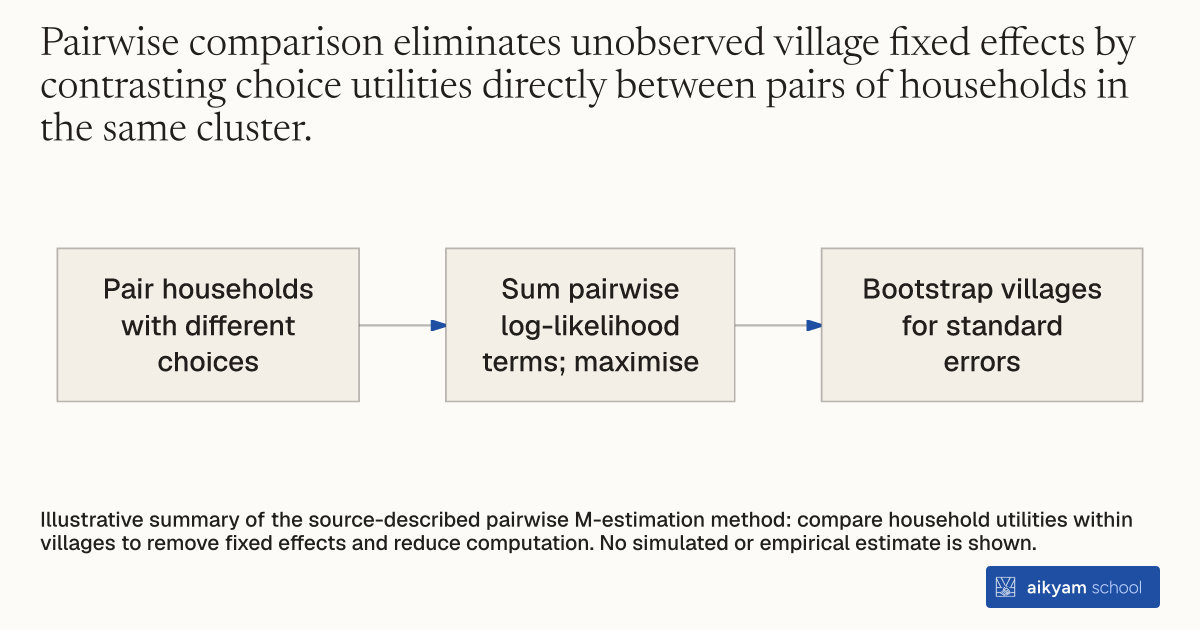
- Pair households with different choices
- Sum pairwise log-likelihood terms; maximise
- Bootstrap villages for standard errors
Illustrative summary of the source-described pairwise M-estimation method: compare household utilities within villages to remove fixed effects and reduce computation. No simulated or empirical estimate is shown.
See source →How
When to use
Econometricians and program evaluators need to estimate non-linear discrete choice models across large clustered datasets. Evaluating full conditional maximum likelihood functions becomes computationally prohibitive when clusters contain many observations or complex choice combinations. Pairwise comparison M-estimation provides a computationally fast method to estimate non-linear preference parameters while controlling for unobserved cluster fixed effects.
Estimate non-linear preference parameters in clustered binary choice models by maximizing an objective function built from pairwise household comparisons within clusters.
- Group individual observations into their respective village clusters.
- Form all unique pairs of households within each village cluster where observed adoption choices differ.
- Construct pairwise log-likelihood components comparing the observable utility difference between the two households in each pair.
- Sum the pairwise conditional probability terms across all valid pairs within each cluster to construct the global objective function.
- Maximize the M-estimator objective function using gradient-based numerical optimization algorithms.
- Calculate standard errors by bootstrapping at the village cluster level to account for within-cluster correlation.
Why it works
This pairwise formulation avoids calculating denominator sums across all combinatorial choice sequences, drastically reducing computational effort while preserving parametric rates of convergence.
Example
Researchers evaluated non-linear bednet adoption parameters across 1,865 households in 129 village clusters in rural Orissa, India. Monte Carlo simulations across sample sizes from 150 to 600 clusters confirmed that pairwise M-estimation yields point estimates close to true values with standard errors shrinking at the square root of sample size.
About the study
Participants
Simulated datasets of 150, 200, 300, and 600 village clusters, alongside empirical baseline data from 1,865 households in 129 villages in Orissa, India, where 93 percent belong to Scheduled Castes, Scheduled Tribes, or Other Backward Castes.
Study Design
Monte Carlo experiments evaluated 150 replications of pairwise comparison M-estimation across 4 cluster sample sizes (150, 200, 300, and 600) for a non-linear conditional logit model with village fixed effects.
Results
Standard errors for risk aversion parameters decreased from 0.2166 at N=150 to 0.1615 at N=300 and 0.1005 at N=600, matching the theoretical square root parametric rate of convergence.