Research analysis
Estimate adoption with village fixed effects
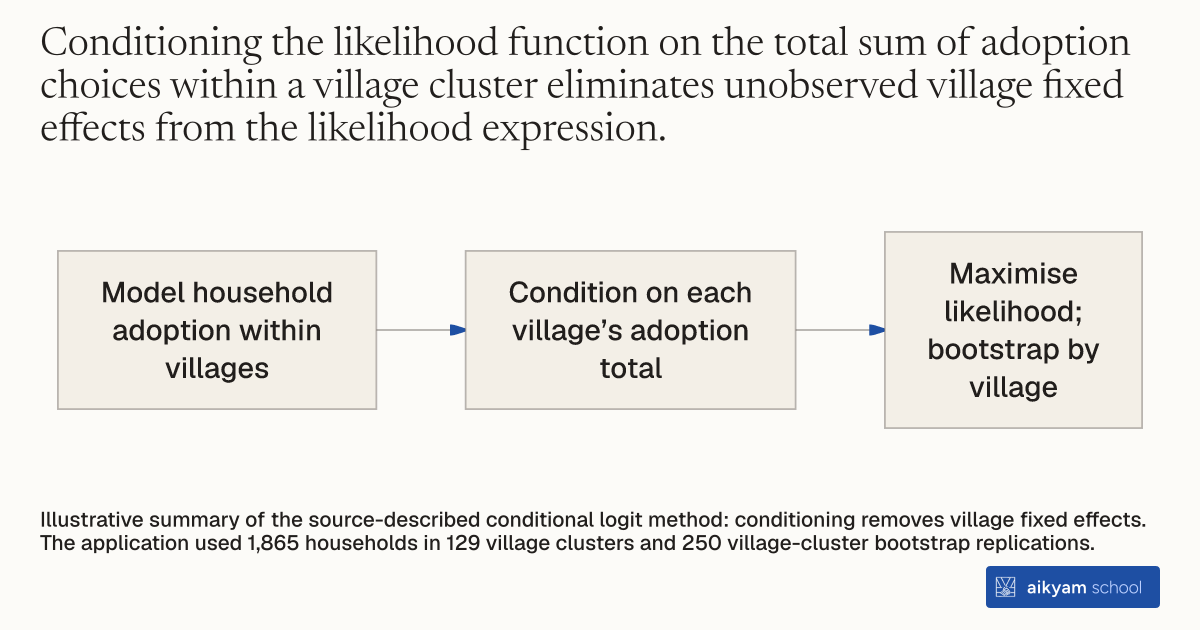
- Model household adoption within villages
- Condition on each village’s adoption total
- Maximise likelihood; bootstrap by village
Illustrative summary of the source-described conditional logit method: conditioning removes village fixed effects. The application used 1,865 households in 129 village clusters and 250 village-cluster bootstrap replications.
See source →How
When to use
Researchers need to estimate preference parameters for technology adoption across clustered communities with unobserved local heterogeneity. Standard discrete choice estimators can produce biased parameter estimates if unobserved village-level characteristics, such as local mosquito density or health infrastructure, correlate with household covariates. Conditional logit estimation with village fixed effects controls for unobserved cluster-level factors by conditioning likelihood functions on total village adoption counts.
Estimate utility parameters for preventive technology purchase while controlling for unobserved cluster heterogeneity using conditional maximum likelihood.
- Specify an individual indirect utility function incorporating observable household covariates, consumption levels, and subjective risk beliefs.
- Add an unobserved village-level fixed effect and an independent, identically distributed standard logistic error term to the latent index function.
- Group surveyed households into their respective village clusters.
- Condition the likelihood of each household's adoption decision on the total number of adoption choices observed within their village cluster to eliminate the village fixed effect.
- Maximize the conditional logit log-likelihood function across all village clusters using gradient-based numerical optimization methods.
- Calculate standard errors by bootstrapping at the village cluster level to adjust for within-village correlation.
Why it works
This allows researchers to estimate preference parameters consistently without specifying a parametric distribution for unobserved cluster-level heterogeneity.
Example
Researchers estimated a conditional logit model of bednet purchase choices across 1,865 households in 129 village clusters in rural Orissa, India. The conditional maximum likelihood estimates showed that household head education significantly increased risk aversion (point estimate 1.90, t-stat 4.01) and perceived community net ownership above 50 percent significantly increased adoption utility (point estimate 0.71, t-stat 5.24).
About the study
Participants
1,865 households in 129 village clusters across 5 districts in Orissa, India, where over 90 percent belong to Scheduled Castes, Scheduled Tribes, or Other Backward Castes.
Study Design
Parametric conditional logit model with additive village fixed effects estimated via conditional maximum likelihood, with standard errors calculated from 250 bootstrap replications clustered at the village level.
Results
Education of household head (point estimate 1.90, t-stat 4.01) and age of head (point estimate 1.80, t-stat 2.86) had positive, statistically significant associations with constant relative risk aversion, while perceived community net ownership above 50 percent directly increased adoption utility (point estimate 0.71, t-stat 5.24).