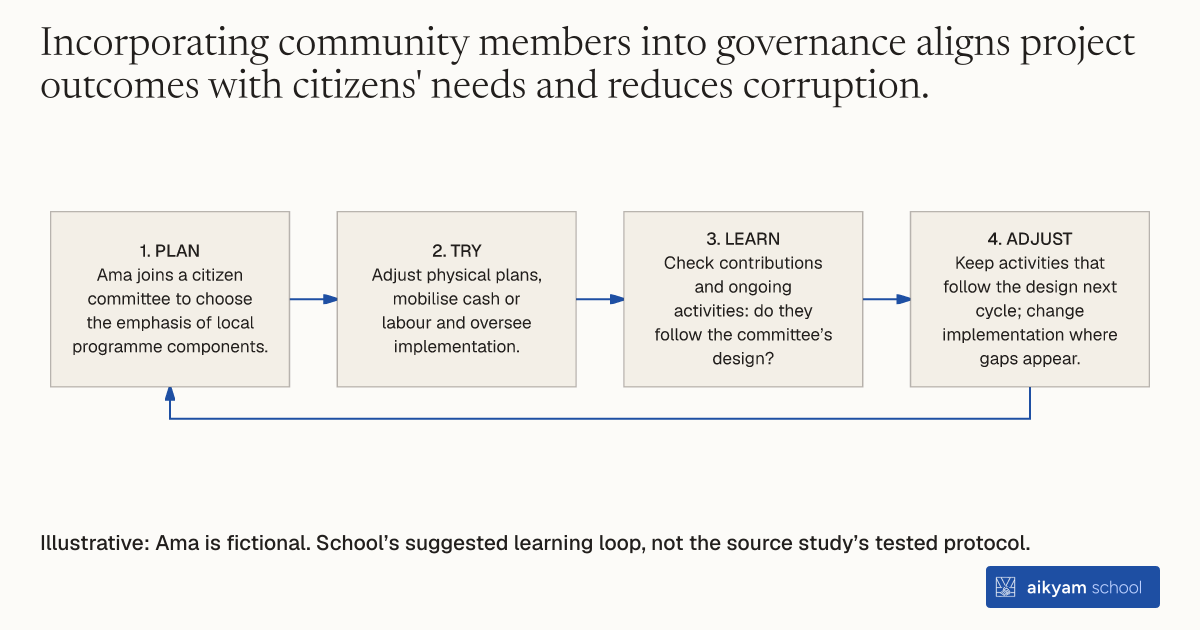
Try, learn and adjust
Check citizen oversight of local programmes
- Plan: Ama joins a citizen committee to choose the emphasis of local programme components.
- Try: Adjust physical plans, mobilise cash or labour and oversee implementation.
- Learn: Check contributions and ongoing activities: do they follow the committee’s design?
- Adjust: Keep activities that follow the design next cycle; change implementation where gaps appear.
Illustrative: Ama is fictional. School’s suggested learning loop, not the source study’s tested protocol.
See source →School’s suggested learning loop: Observe committee decisions, local contributions and programme implementation; no impact is inferred.
How
When to use
Rural development programs often fail to address specific local needs when managed strictly by external actors. Participatory citizen committee governance creates local committees to oversee, adapt, and implement development initiatives. The method serves rural citizens and local leaders seeking community oversight and tailored program implementation.
Establish and empower a local citizen committee to oversee program activities and mobilize local resources.
- Form a committee of local citizens within the targeted community grouping.
- Authorize the committee to influence the program design by deciding how much emphasis to place on various programming components.
- Allow the committee to adjust physical plans, such as deciding whether or not to construct a community center.
- Task the committee with overseeing program implementation across the local community.
- Direct the committee to mobilize local contributions in labor and cash to support community activities.
- Instruct the committee to monitor ongoing programming and coordinate with local leadership.
Why it works
It also reduces dependence on outside resources during project implementation.
Example
The Hunger Project established citizen committees across 51 assigned village groupings in Eastern Ghana, where 1.5 percent of adults served as committee members and committees in 28 groupings mobilized community resources for development activities.
About the study
Participants
2,744 households across 97 village groupings in 13 districts of Eastern Ghana.
Study Design
Randomized evaluation using public lotteries to assign 51 village groupings to treatment and 46 to control over a five-year period.
Results
Serving as a committee member reached 1.5 percent of adults in treated villages, and active mobilization increased epicenter-related household contributions by 58.5 GHC, though non-epicenter public goods contributions fell by 10 GHC.