Try, learn and adjust
Check community-selected demonstrators receive seed
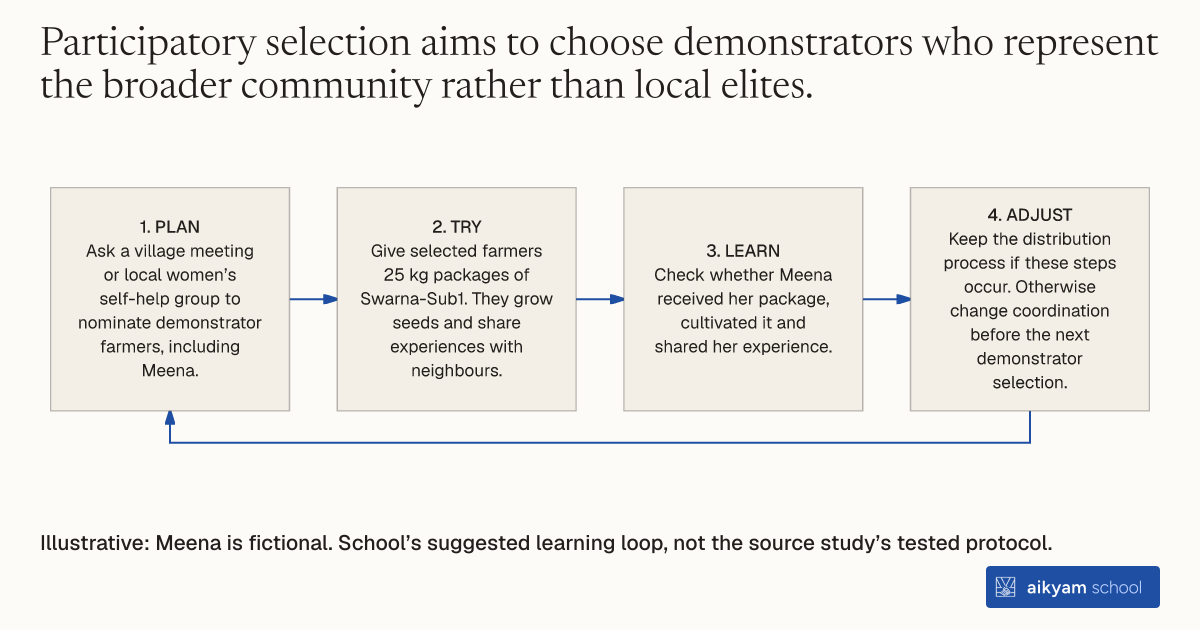
- Plan: Ask a village meeting or local women’s self-help group to nominate demonstrator farmers, including Meena.
- Try: Give selected farmers 25 kg packages of Swarna-Sub1. They grow seeds and share experiences with neighbours.
- Learn: Check whether Meena received her package, cultivated it and shared her experience.
- Adjust: Keep the distribution process if these steps occur. Otherwise change coordination before the next demonstrator selection.
Illustrative: Meena is fictional. School’s suggested learning loop, not the source study’s tested protocol.
See source →School’s suggested learning loop: observe nomination, seed receipt and sharing. The study found no adoption difference between selection methods.
How
When to use
Agricultural extension programs often rely on local leaders to select demonstrator farmers who receive seed packages. Program managers use participatory community meetings or local self-help groups to choose representative demonstrators. This method tests whether community-led selection improves technology adoption compared to elite selection.
Select demonstrator farmers through community meetings or local women self-help groups to host demonstration plots.
- Program managers establish target agricultural villages for seed extension activities.
- Field staff organize participatory village meetings or engage local women self-help groups in target communities.
- Community members or group representatives nominate local farmers to serve as seed demonstrators.
- Program distributors allocate 25 kg seed packages of Swarna-Sub1 to the selected demonstrator farmers.
- Selected demonstrators cultivate the seeds on their plots and share their experiences with visiting neighbors.
Why it works
However, varying the selection method does not significantly alter ultimate technology adoption rates among neighboring farmers.
Example
In 100 villages in Balasore district, Odisha, researchers tested three demonstrator selection methods: local leader selection, participatory selection in village meetings, and selection by women's self-help groups. Varying the demonstrator selection method produced no significant difference in seed adoption rates.
About the study
Participants
100 villages in Balasore district, Odisha, India.
Study Design
Randomized evaluation allocating 25 kg seed packages using local leader selection, participatory village meetings, or women's self-help groups across 100 villages.
Results
Varying the selection method for demonstrator farmers receiving minikits did not affect seed adoption rates among neighboring villagers.