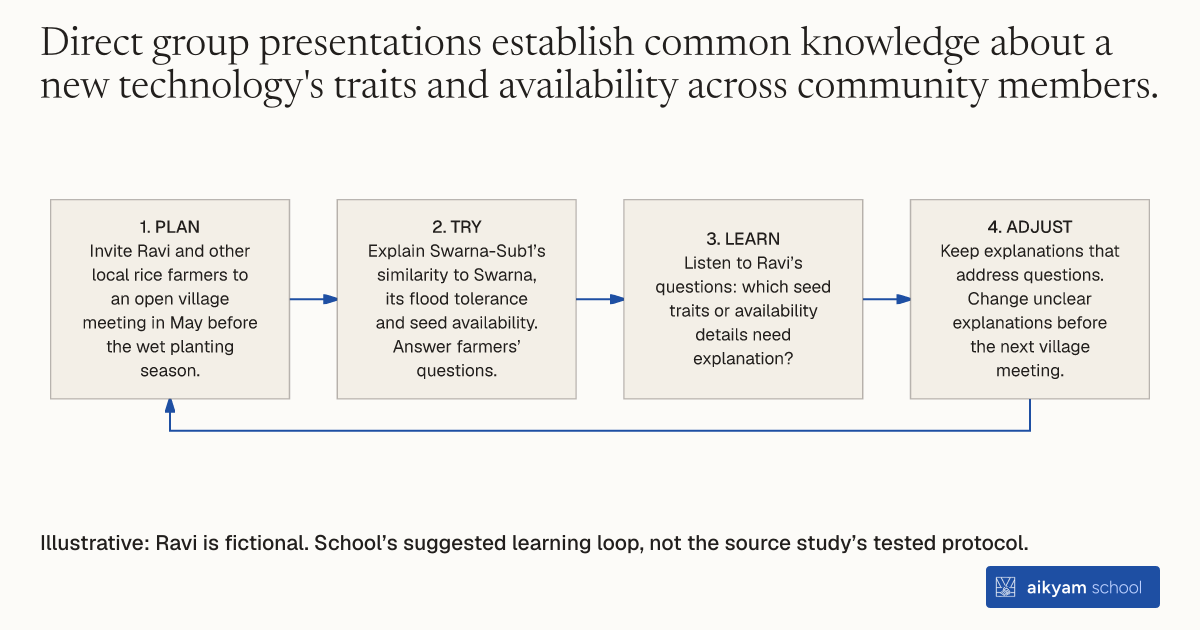
Try, learn and adjust
Check questions about the new seed variety
- Plan: Invite Ravi and other local rice farmers to an open village meeting in May before the wet planting season.
- Try: Explain Swarna-Sub1’s similarity to Swarna, its flood tolerance and seed availability. Answer farmers’ questions.
- Learn: Listen to Ravi’s questions: which seed traits or availability details need explanation?
- Adjust: Keep explanations that address questions. Change unclear explanations before the next village meeting.
Illustrative: Ravi is fictional. School’s suggested learning loop, not the source study’s tested protocol.
See source →School’s suggested, untested loop: observe questions about seed traits and availability; a meeting alone does not establish adoption.
How
When to use
Farmers in rural areas often lack information about new crop varieties that resist local climate risks like flooding. Holding open village meetings introduces farmers to flood-tolerant seeds and explains their features directly. This provides a baseline level of awareness across the community prior to technology dissemination.
Convene open village meetings to introduce new crop varieties to local farmers.
- Program facilitators visit target villages in May prior to the wet planting season.
- Facilitators invite all local rice-cultivating farmers in the community to attend an information session.
- Presenters deliver a brief overview of Swarna-Sub1 seed characteristics to meeting attendees.
- Presenters explain the similarity of Swarna-Sub1 to traditional Swarna seeds and highlight its flood-tolerance traits.
- Presenters inform farmers about seed availability and answer questions from attending community members.
Why it works
This ensures that farmers understand the benefits of flood tolerance before deciding whether to adopt or seek out seeds.
Example
In May 2012, researchers visited 82 villages in Bhadrak district, Odisha, India, and held meetings attended by 15 to 41 rice-cultivating farmers per village, with average attendance being 22 farmers.
About the study
Participants
82 rural villages in Bhadrak district, Odisha, India, with an average of 22 rice-cultivating farmers attending per village.
Study Design
Randomized field evaluation convening open meetings in May 2012 across 82 villages to present Swarna-Sub1 seed characteristics.
Results
Information meetings achieved average attendance of 22 farmers per village (ranging from 15 to 41 attendees) and established initial technology awareness across all 82 study communities.