Research design
Allocate assistance through public lotteries
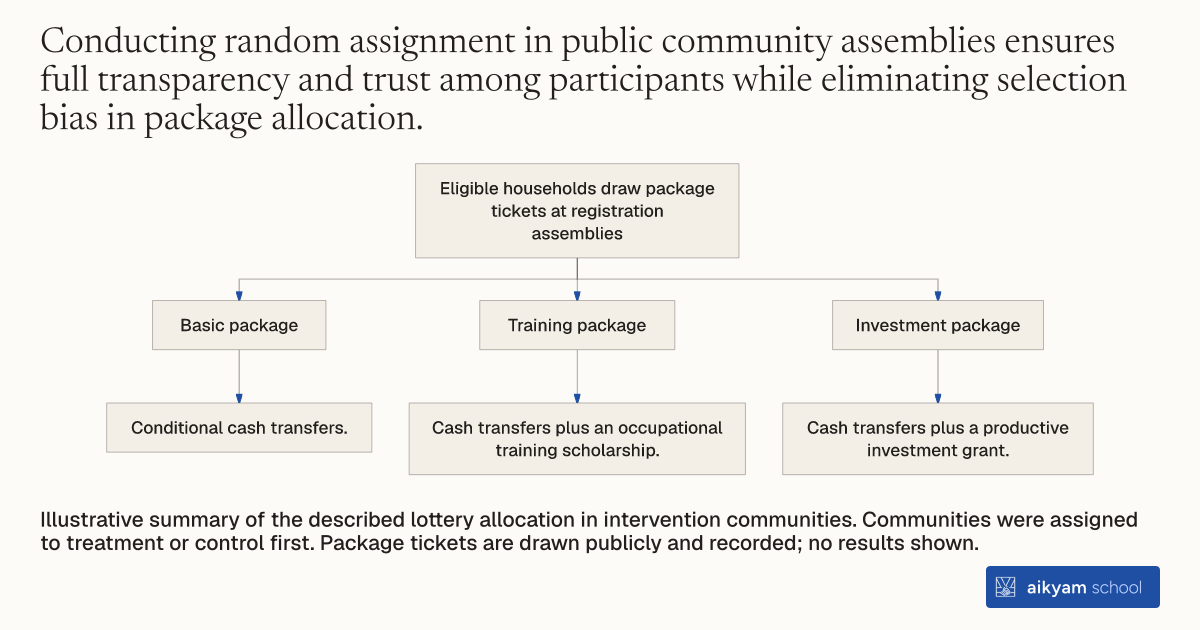
Eligible households draw package tickets at registration assemblies
- Basic package
- Conditional cash transfers.
- Training package
- Cash transfers plus an occupational training scholarship.
- Investment package
- Cash transfers plus a productive investment grant.
Illustrative summary of the described lottery allocation in intervention communities. Communities were assigned to treatment or control first. Package tickets are drawn publicly and recorded; no results shown.
See source →How
When to use
Development programs often offer multiple complementary assistance packages to impoverished households. Assigning these packages transparently prevents perceptions of corruption, community conflict, and administrative favoritism among beneficiaries. Organizing public assemblies where female household caregivers draw program packages by lottery ensures transparent random allocation.
Allocate differentiated social assistance packages among eligible beneficiaries using transparent public assemblies and lotteries.
- Identify eligible poor households within target intervention communities using poverty status criteria.
- Invite the primary female caregiver from each eligible household to a registration assembly in her community.
- Convene all invited beneficiaries at the end of the registration assembly to conduct a public lottery.
- Have each participant draw a package ticket randomly from the lottery container in full view of the community.
- Record each household's assigned package—such as basic cash transfers, occupational training scholarships, or productive investment grants—on official beneficiary rosters.
Example
In rural northwest Nicaragua, the Ministry of the Family invited primary female caregivers from 3,000 eligible households across 56 intervention communities to registration assemblies. At the end of each assembly, beneficiaries participated in a public lottery that randomly allocated three program packages: basic conditional cash transfers, cash transfers plus occupational training scholarships, and cash transfers plus productive investment grants.
About the study
Participants
3,000 eligible poor households across 56 intervention communities in 6 rural municipalities in northwest Nicaragua.
Study Design
Two-stage randomized controlled trial where communities were first randomly assigned to treatment or control, followed by individual household public lotteries to assign program packages.
Results
Participation by invited beneficiaries in assemblies and lotteries was near 100 percent, achieving balanced baseline socio-economic characteristics across treatment arms and near 100 percent take-up of productive investment grants.