Try, learn and adjust
Check peak-hour transit subsidies
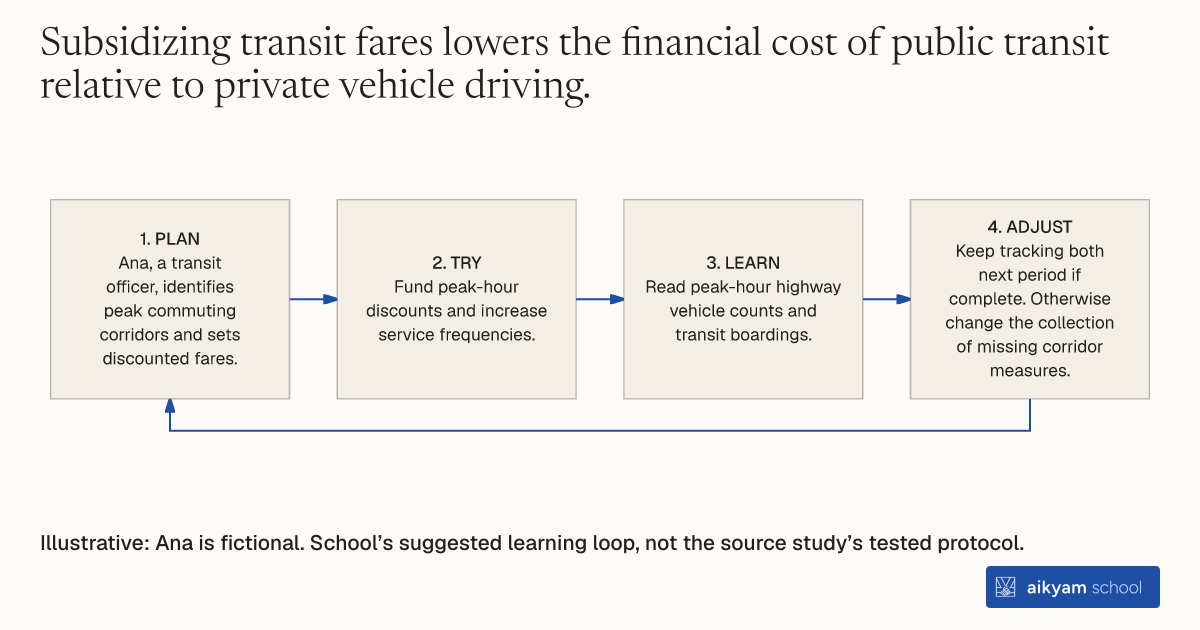
- Plan: Ana, a transit officer, identifies peak commuting corridors and sets discounted fares.
- Try: Fund peak-hour discounts and increase service frequencies.
- Learn: Read peak-hour highway vehicle counts and transit boardings.
- Adjust: Keep tracking both next period if complete. Otherwise change the collection of missing corridor measures.
Illustrative: Ana is fictional. School’s suggested learning loop, not the source study’s tested protocol.
See source →School’s suggested, untested learning loop. Observe peak-hour fares, transit ridership and highway traffic; this loop does not establish congestion benefits.
How
When to use
Urban roadways experience heavy peak-hour vehicular congestion during daily commuting periods. High private vehicle travel increases fuel consumption and local highway delays. Municipal transit authorities need targeted financial subsidies to shift commuters into public transportation during peak hours.
Provide subsidized public transit fares during peak rush-hour travel periods to reduce roadway congestion.
- Transit authority staff analyze weekday traffic patterns to identify peak commuting corridors.
- Program managers set discounted fare rates for subway, rail, and bus transit options during morning and evening rush hours.
- Municipalities fund transit subsidies through local transport budget allocations or congestion pricing revenue.
- Transit operators increase peak-hour train and bus frequencies to accommodate expanded passenger volumes.
- Analysts monitor peak-hour highway vehicle counts and transit ridership changes across urban corridors.
Why it works
Shifting rush-hour commuters onto public transit creates substantial traffic congestion relief for remaining road users.
Example
In Rotterdam, Netherlands and Los Angeles, California, public transit subsidies reduced urban road congestion during peak hours, delivering congestion relief benefits valued between \$1.20 and \$4.10 per peak-hour transit passenger mile in Los Angeles.
About the study
Participants
Commuters and transit passengers in Rotterdam, Netherlands and Los Angeles, California.
Study Design
Quasi-experimental natural experiment designs evaluating transit strikes, fare changes, and highway traffic speeds.
Results
Transit subsidies generated congestion relief benefits equal to 50 percent of the subsidy level in Rotterdam and \$1.20 to \$4.10 per peak-hour transit passenger mile in Los Angeles.