Try, learn and adjust
Check broadcasts use peak listening windows
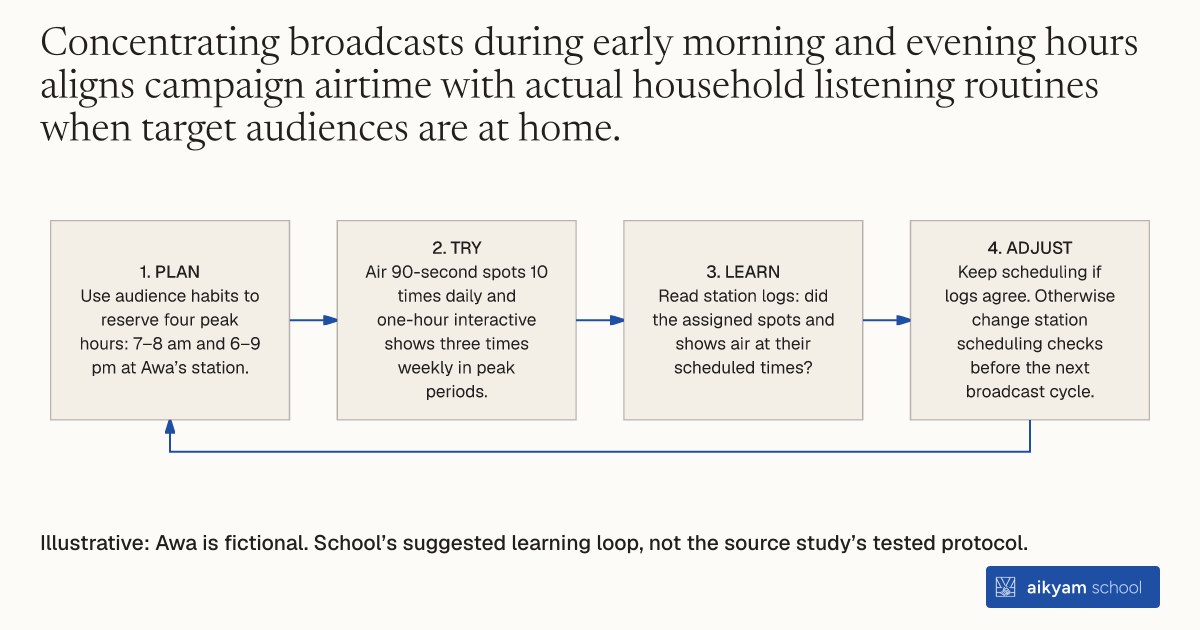
- Plan: Use audience habits to reserve four peak hours: 7–8 am and 6–9 pm at Awa’s station.
- Try: Air 90-second spots 10 times daily and one-hour interactive shows three times weekly in peak periods.
- Learn: Read station logs: did the assigned spots and shows air at their scheduled times?
- Adjust: Keep scheduling if logs agree. Otherwise change station scheduling checks before the next broadcast cycle.
Illustrative: Awa is fictional. School’s suggested learning loop, not the source study’s tested protocol.
See source →School’s suggested, untested learning loop. Observe broadcast times and frequency. These components belong to the wider campaign, not separate proven effects.
How
When to use
In developing regions, public health radio campaigns often fail to reach rural listeners because broadcasts air during daytime hours when target audiences work in fields. Campaign managers want to maximize message exposure and salience without paying for round-the-clock airtime across local stations. Scheduling short spots and interactive programs during early morning and evening hours ensures maximum audience reach among rural women and men.
Concentrate campaign broadcasts during high-audience morning and evening time windows to maximize exposure among rural listeners.
- Survey baseline audience habits to identify peak listening windows, such as early morning between 7:00 AM and 8:00 AM and evening between 6:00 PM and 9:00 PM.
- Negotiate broadcast contracts with local radio station managers to reserve 4 prime-time hours per day.
- Schedule 90-second behavior change spots 10 times daily during early morning and evening peak hours.
- Broadcast 1-hour interactive phone-in shows three times per week during evening peak listening periods.
- Replace approximately 17 percent of peak listening airtime with target health campaign content.
- Track station logs continuously throughout multi-year campaigns to verify that health content replaces passive debate and call-in programming.
Why it works
High peak-time frequency increases message salience and captures a significant share of total audience attention without needing 24-hour broadcast dominance.
Example
In Burkina Faso, Development Media International concentrated its family planning radio campaign across 4 peak listening hours (7-8 AM and 6-9 PM) across 8 treatment radio stations reaching 5.1 million people. DMI replaced 17 percent of peak airtime with 90-second spots broadcast 10 times daily and three weekly interactive shows. This peak scheduling increased the share of women hearing radio family planning messages from 76 percent to 97 percent and boosted modern contraceptive prevalence by 5.9 percentage points.
About the study
Participants
7,515 women and 461 health clinics across 16 radio station broadcast zones covering 5.1 million people in Burkina Faso.
Study Design
Pairwise cluster randomized controlled trial evaluating a 2.5-year radio broadcast scheduling campaign across 8 treatment stations.
Results
Scheduling campaign content during 4 peak daily hours replaced 17 percent of peak airtime, increased weekly listenership to health shows from 13 to 23 percent, increased modern contraceptive use by 5.9 percentage points, and increased monthly clinic family planning consultations by 32 percent.