Try, learn and adjust
Check commissions follow delivered payments
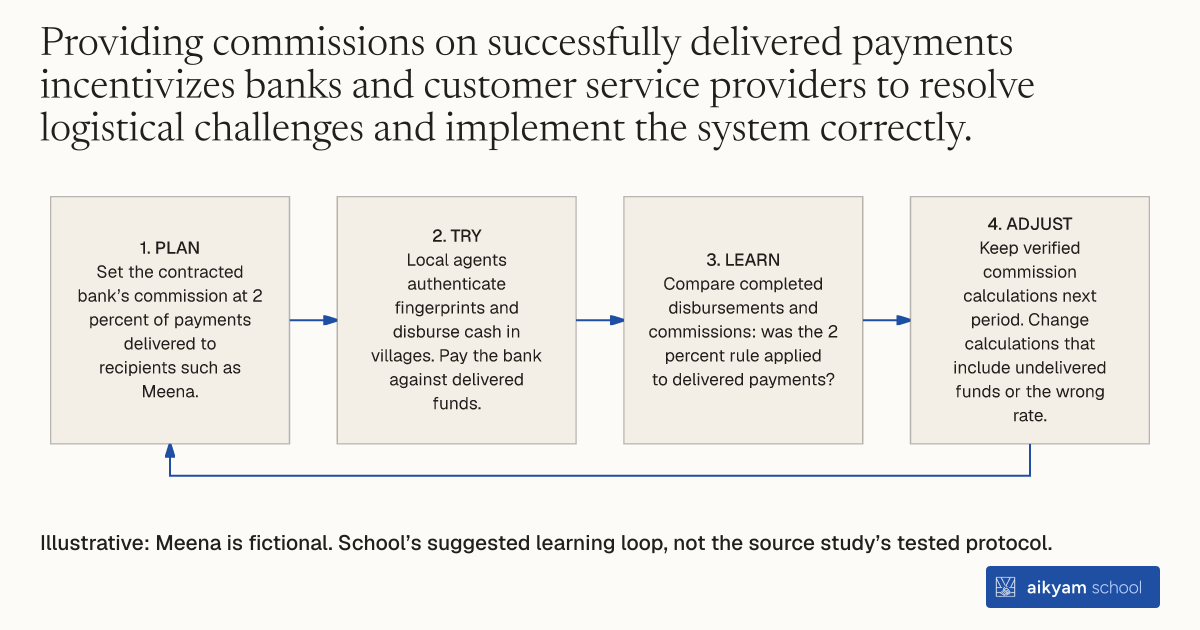
- Plan: Set the contracted bank’s commission at 2 percent of payments delivered to recipients such as Meena.
- Try: Local agents authenticate fingerprints and disburse cash in villages. Pay the bank against delivered funds.
- Learn: Compare completed disbursements and commissions: was the 2 percent rule applied to delivered payments?
- Adjust: Keep verified commission calculations next period. Change calculations that include undelivered funds or the wrong rate.
Illustrative: Meena is fictional. School’s suggested learning loop, not the source study’s tested protocol.
See source →School’s suggested, untested loop. Observe delivered cash and bank commissions. The wider payment-system evaluation does not isolate commission effects.
How
When to use
Government payment reforms often stall because financial intermediaries lack motivation to deliver funds efficiently. Paying a percentage-based commission on delivered funds incentivizes contracted banks and service providers to distribute social welfare payments correctly. This aligns implementation interests across payment providers and rural program beneficiaries.
Offer percentage-based commission fees to contracted banks and service providers tied directly to the volume of social assistance funds successfully disbursed.
- Government agencies contract private banks to manage social assistance distribution across targeted administrative sub-districts.
- Program administrators set a performance-based commission rate of 2 percent on all payments delivered to beneficiaries.
- Contracted banks deploy local customer service providers to village locations to process biometric payment transactions.
- Local providers authenticate beneficiary identities using fingerprint readers and disburse cash payments directly in villages.
- Government agencies calculate total successfully delivered disbursements and pay contracted banks the 2 percent commission fee.
Why it works
Aligned financial incentives motivate service providers to ensure payments reach intended recipients in a timely manner.
Example
The Government of Andhra Pradesh incentivized contracted banks and Customer Service Providers by rewarding them a 2 percent commission on all NREGS and SSP payments delivered. This financial commission helped sustain the rollout across 296 sub-districts, where total annual system operating costs were US\$4 million for NREGS and US\$2.3 million for SSP.
About the study
Participants
8,000 households in 8 districts of Andhra Pradesh, covering a rural population of nineteen million people.
Study Design
Cluster-randomized controlled trial across 296 sub-districts randomly assigned to early rollout (treatment) or delayed rollout (comparison) over two years.
Results
Paying a 2 percent commission supported payment delivery across treatment areas, contributing to a US\$38.5 million annual leakage reduction for NREGS and US\$3.2 million for SSP against annual implementation costs of US\$4 million for NREGS and US\$2.3 million for SSP.