Try, learn and adjust
Check personalised employment support is sustained
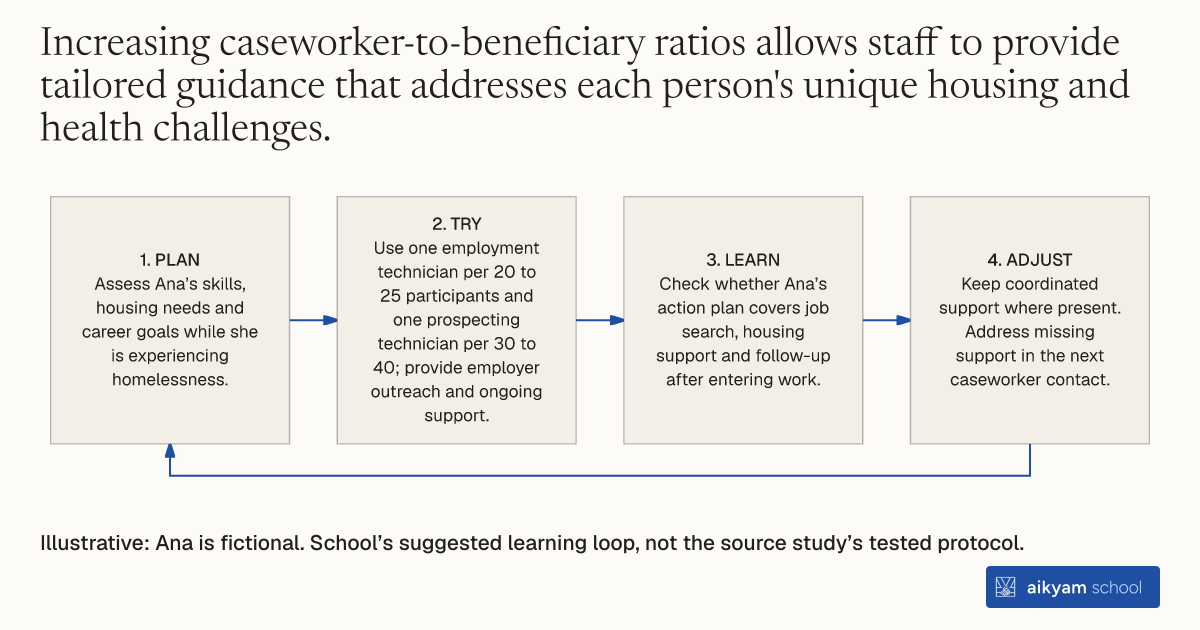
- Plan: Assess Ana’s skills, housing needs and career goals while she is experiencing homelessness.
- Try: Use one employment technician per 20 to 25 participants and one prospecting technician per 30 to 40; provide employer outreach and ongoing support.
- Learn: Check whether Ana’s action plan covers job search, housing support and follow-up after entering work.
- Adjust: Keep coordinated support where present. Address missing support in the next caseworker contact.
Illustrative: Ana is fictional. School’s suggested learning loop, not the source study’s tested protocol.
See source →School’s suggested, untested loop: observe personalised plans, employer mediation and continuing support, including after job entry.
How
When to use
Individuals experiencing homelessness face complex barriers to employment, including physical health issues and housing instability. Standard, blanket employment support fails to address the varied personal experiences of homeless job seekers. This method provides flexible, personalized casework with high staff-to-beneficiary ratios to help homeless individuals secure stable housing and job opportunities.
Provide intensive, flexible employment support to homeless individuals by increasing caseworker ratios and creating personalized inclusion plans.
- Caseworkers conduct individual intake assessments with homeless participants to identify personal skills, housing needs, and career goals.
- Program leaders assign one employment technician for every 20 to 25 participants and one prospecting technician for every 30 to 40 participants.
- Caseworkers design personalized action plans covering job search training, skill building, and housing stabilization.
- Prospecting technicians conduct direct employer outreach and mediation with local businesses to locate job vacancies.
- Caseworkers deliver ongoing monitoring and personal support to participants after they enter employment.
Why it works
Direct employer mediation and post-employment support help participants maintain job retention and housing security.
Example
Hogar Sí (Fundación RAIS) delivered a personalized employment support model to 224 homeless individuals across six Spanish cities over six to eighteen months. Caseworkers provided flexible support and employer mediation with high staffing ratios. Compared to traditional services, the personalized model increased participant job application intensity, raised earned income, improved housing stability, and increased days worked by 14 days over six months.
About the study
Participants
462 individuals experiencing homelessness (224 treatment group, 238 comparison group) across six Spanish cities.
Study Design
Randomised Controlled Trial (RCT) evaluating a personalized labour market insertion model with high caseworker ratios delivered over 6 to 18 months by Hogar Sí (Fundación RAIS).
Results
The new model improved participants' housing conditions, particularly in terms of housing stability, safety, and overall life satisfaction, increased earned income and job applications, and increased days worked by approximately 14 days during the six months following the intervention.