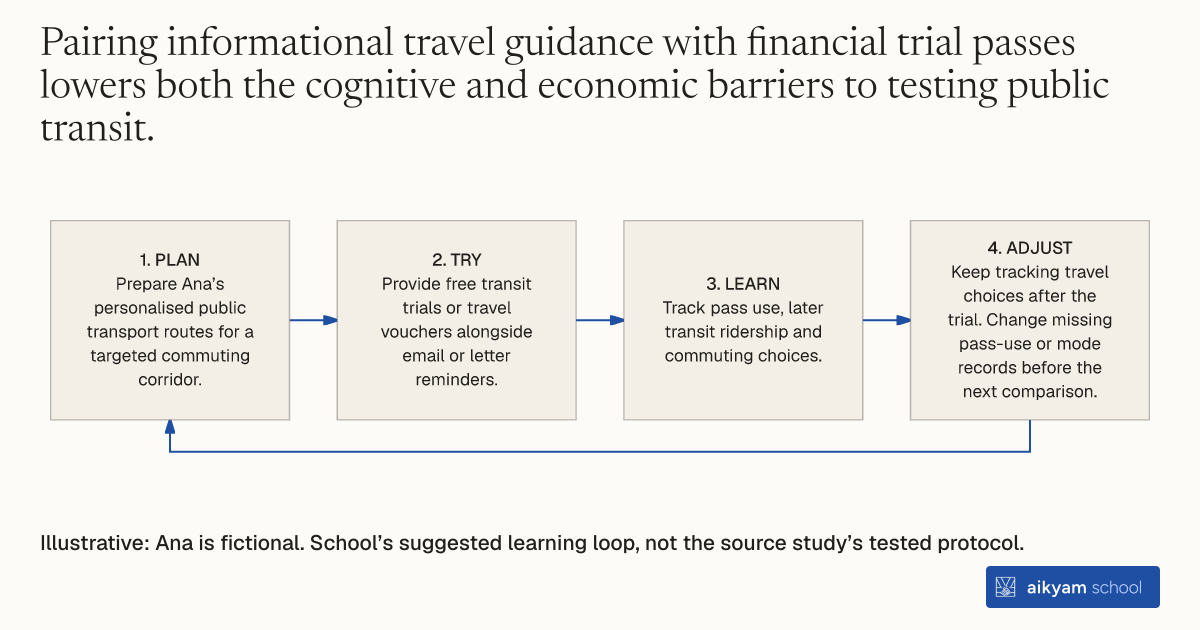
Try, learn and adjust
Check combined travel advice and transit trials
- Plan: Prepare Ana’s personalised public transport routes for a targeted commuting corridor.
- Try: Provide free transit trials or travel vouchers alongside email or letter reminders.
- Learn: Track pass use, later transit ridership and commuting choices.
- Adjust: Keep tracking travel choices after the trial. Change missing pass-use or mode records before the next comparison.
Illustrative: Ana is fictional. School’s suggested learning loop, not the source study’s tested protocol.
See source →School’s suggested learning loop: observe travel choices. The review reports small overall shifts; neither information nor financial incentives alone produced detectable changes.
How
When to use
Municipalities face high traffic congestion and motor vehicle emissions from single-occupant commuters. Commuters cling to automobile habits despite public transport alternatives. Travel management campaigns distribute personalized travel plans or free transit passes to persuade drivers to switch modes.
Combine personalized travel planning with free transit trial passes to reduce single-occupancy vehicle commuting.
- Identify targeted urban commuting corridors and automobile driver populations.
- Develop customized travel plans outlining optimal public transit routes for individual participants.
- Provide free bus trial passes or monetary travel vouchers directly to selected commuters.
- Send informational nudges, such as email or letter reminders, encouraging transit trial participation.
- Track post-trial transit ridership and commuting mode shifts over time.
Why it works
Combining nudges with financial subsidies produces greater potential behavior shifts than applying either strategy in isolation.
Example
Commuter demand management programs in Massachusetts and the United Kingdom provided free bus trials, personalized travel plans, and informational emails to drivers. Evaluators found that neither financial incentives nor informational nudges alone changed commuting habits, though combining both strategies achieved modest behavioral shifts.
About the study
Participants
Commuters and automobile drivers across Massachusetts in the United States and nationwide across the United Kingdom.
Study Design
Randomized controlled trials measuring commuter mode selection, public transit pass redemption, and actual travel choices.
Results
Neither informational nudges nor monetary incentives alone produced detectable shifts in commuting choices. Combining personalized travel plans with free bus trials showed the greatest potential to alter travel habits, though overall commuter behavior shifts remained small.