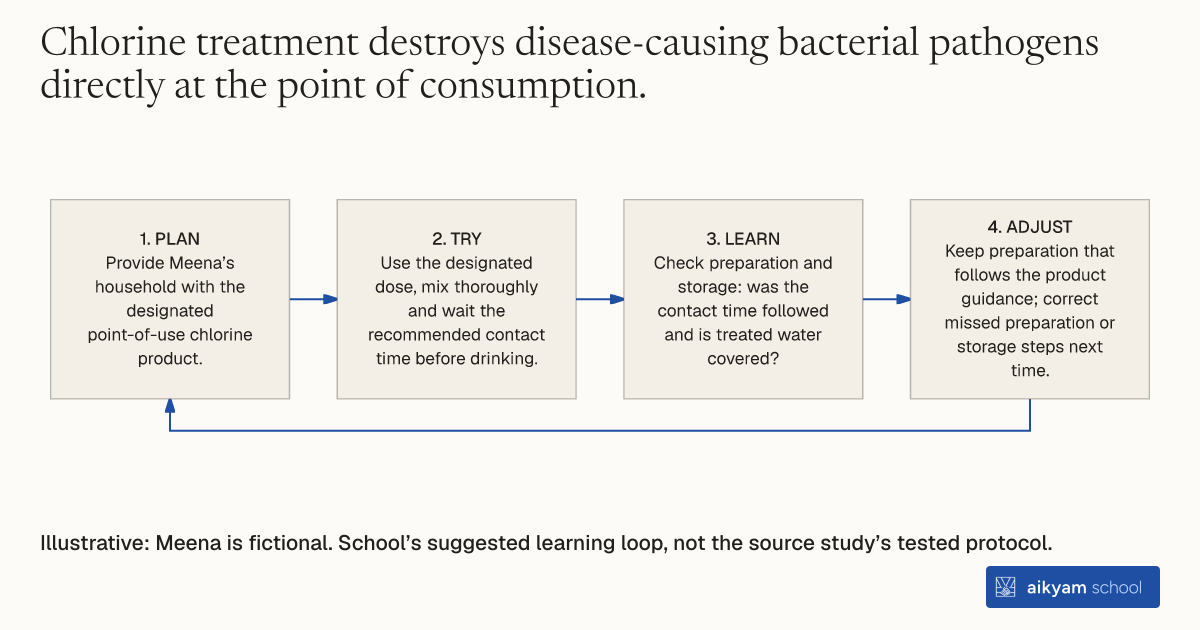
Try, learn and adjust
Check household water-treatment steps
- Plan: Provide Meena’s household with the designated point-of-use chlorine product.
- Try: Use the designated dose, mix thoroughly and wait the recommended contact time before drinking.
- Learn: Check preparation and storage: was the contact time followed and is treated water covered?
- Adjust: Keep preparation that follows the product guidance; correct missed preparation or storage steps next time.
Illustrative: Meena is fictional. School’s suggested learning loop, not the source study’s tested protocol.
See source →School’s suggested learning loop, not a tested protocol. Observe designated dosing, mixing, recommended contact time and covered storage. This loop supplies no dosing instructions.
How
When to use
Source drinking water often suffers recontamination during transit and home storage in rural communities. Point-of-use in-home chlorination provides chemical disinfection directly inside household storage containers. This protects household drinking water for families lacking clean piped water connections.
Treat household drinking water at the point of use using chlorine disinfectant products to maintain residual protection against microbial contamination.
- Distributors or public health officials provide household-level point-of-use chlorination products directly to families.
- Household water collectors treat freshly collected water inside storage vessels using designated liquid chlorine doses.
- Household water collectors mix the chlorine thoroughly into the stored water.
- Household water collectors allow the treated water to stand for the recommended contact time before drinking.
- Family members store treated water in covered containers to maintain disinfectant residuals and prevent subsequent recontamination.
Why it works
Chemical disinfectant residuals remain active in stored water, preventing recontamination during transport and household storage.
Example
Following a 2005 cholera outbreak in western Kenya, the government distributed free chlorine products to rural households, leading 29 percent of surveyed households to report chlorinating their water in the subsequent six months, though usage dropped to 8 percent in the second follow-up survey.
About the study
Participants
1,354 households across 184 spring communities in Busia and Butere-Mumias districts, Kenya.
Study Design
In-home point-of-use chlorination product distribution evaluated through longitudinal household surveys and follow-up water quality testing.
Results
In the 2005 follow-up survey after government free chlorine distribution, 29% of households reported chlorinating water at least once in the past six months, declining to 8% reporting chlorination in the past week during the 2006 survey round.