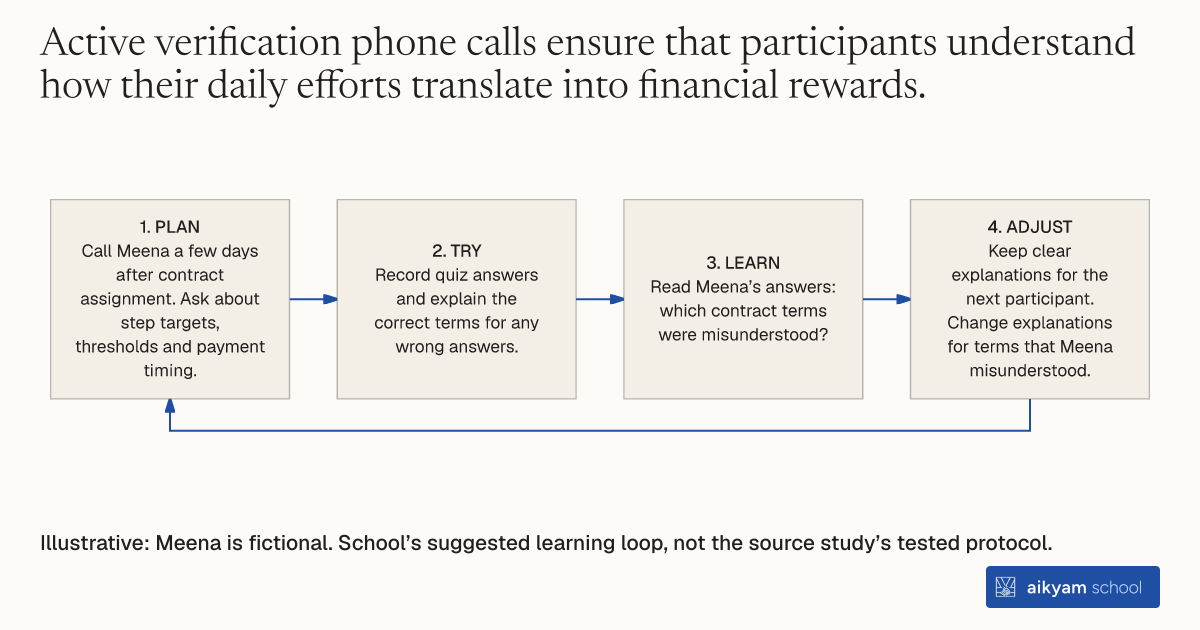
Try, learn and adjust
Check understanding of the assigned contract
- Plan: Call Meena a few days after contract assignment. Ask about step targets, thresholds and payment timing.
- Try: Record quiz answers and explain the correct terms for any wrong answers.
- Learn: Read Meena’s answers: which contract terms were misunderstood?
- Adjust: Keep clear explanations for the next participant. Change explanations for terms that Meena misunderstood.
Illustrative: Meena is fictional. School’s suggested learning loop, not the source study’s tested protocol.
See source →School’s suggested, untested loop: observe quiz answers and corrective explanations; do not change assigned contract terms.
How
When to use
Health and incentive programs introduce complex payment rules and thresholds that participants may misunderstand. Unclear contract terms can cause participants to miss targets or abandon program goals. This method serves individuals enrolled in health behavior interventions in community settings.
Conduct follow-up verification phone calls shortly after assigning contract rules to test comprehension and re-explain terms.
- Contact participants by telephone a few days after their initial contract assignment.
- Administer a structured questionnaire testing knowledge of specific contract parameters, including daily step targets, threshold rules, and payment schedules.
- Review answers immediately and identify any incorrect responses regarding contract conditions.
- Explain the correct contract rules and payment terms to participants who miss survey questions.
- Record understanding verification scores in the central database to confirm contract salience across treatment arms.
Why it works
Immediate corrective explanation prevents misconceptions from reducing task effort or compliance.
Example
Surveyors conducted phone audits a few days after contract assignment for trial participants in Coimbatore, India. Audit responses confirmed high contract comprehension across treatment arms, and surveyors provided immediate explanations whenever a participant answered incorrectly.
About the study
Participants
3,192 enrolled participants across Coimbatore, India, with an average age of 49.56 years, 42 percent female, 67 percent diagnosed diabetic, and an average monthly per capita income of 4,465 INR.
Study Design
Surveyors called participants a few days after contract assignment to administer a quiz testing contract understanding, re-explaining rules for any incorrect responses.
Results
Phone audits confirmed that a vast majority of participants understood their assigned contracts, ensuring contract salience prior to the 12-week intervention period.