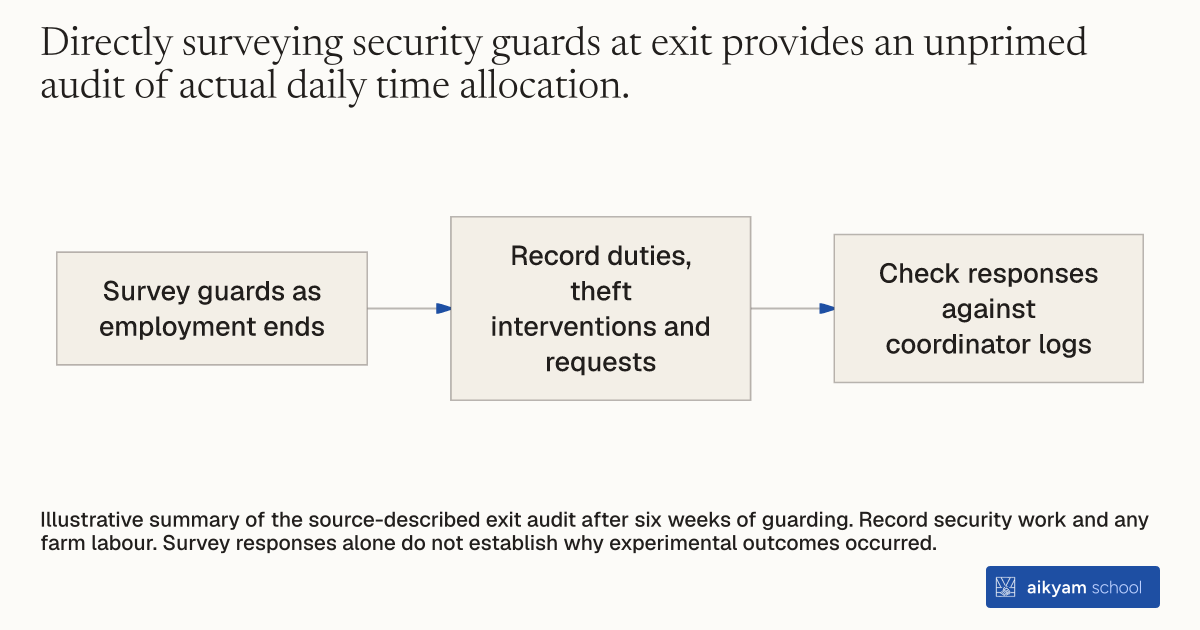
Research procedure
Audit guards at the end of deployment
- Survey guards as employment ends
- Record duties, theft interventions and requests
- Check responses against coordinator logs
Illustrative summary of the source-described exit audit after six weeks of guarding. Record security work and any farm labour. Survey responses alone do not establish why experimental outcomes occurred.
See source →How
When to use
Subsidized security interventions risk failure if hired guards are diverted to non-security agricultural labor by host farmers. Without activity auditing, researchers cannot verify whether observed farm productivity gains stem from enhanced property protection or from extra subsidized farm labor. This method conducts systematic post-deployment surveys of security personnel to confirm duty compliance.
Audit security guard activities at the conclusion of their employment using structured exit surveys to verify task compliance.
- Administer exit surveys to watchmen as they finish their employment period and prepare to leave the field site.
- Record whether watchmen performed strictly security work versus non-security agricultural field tasks.
- Measure the frequency of guard interventions to prevent active theft during their deployment period.
- Track whether host farmers ever requested guards to perform regular manual farm labor.
- Cross-check guard survey responses with field coordinator audit logs to confirm that security duties remained uncompromised.
Why it works
This verifies that experimental treatment effects are driven purely by property protection rather than subsidized manual farm labor.
Example
Researchers surveyed Maasai watchmen in Migori County, Kenya as they finished their guarding deployment and prepared to return to Narok. The exit audit confirmed that watchmen performed strictly security work and were not diverted to manual farm labor.
About the study
Participants
Sample of deployed Maasai watchmen guarding 585 smallholding farms across 76 villages in Migori County, Kenya.
Study Design
Post-deployment exit survey administered to guards at the end of their six-week employment period to measure active theft interventions and labor task compliance.
Results
Exit surveys showed that 100% of watchmen performed strictly security work, 0% were diverted to non-security farm labor, and watchmen intervened an average of 1.5 times to prevent active crop theft during their deployment.