Research steps
Recall spending after wage payments
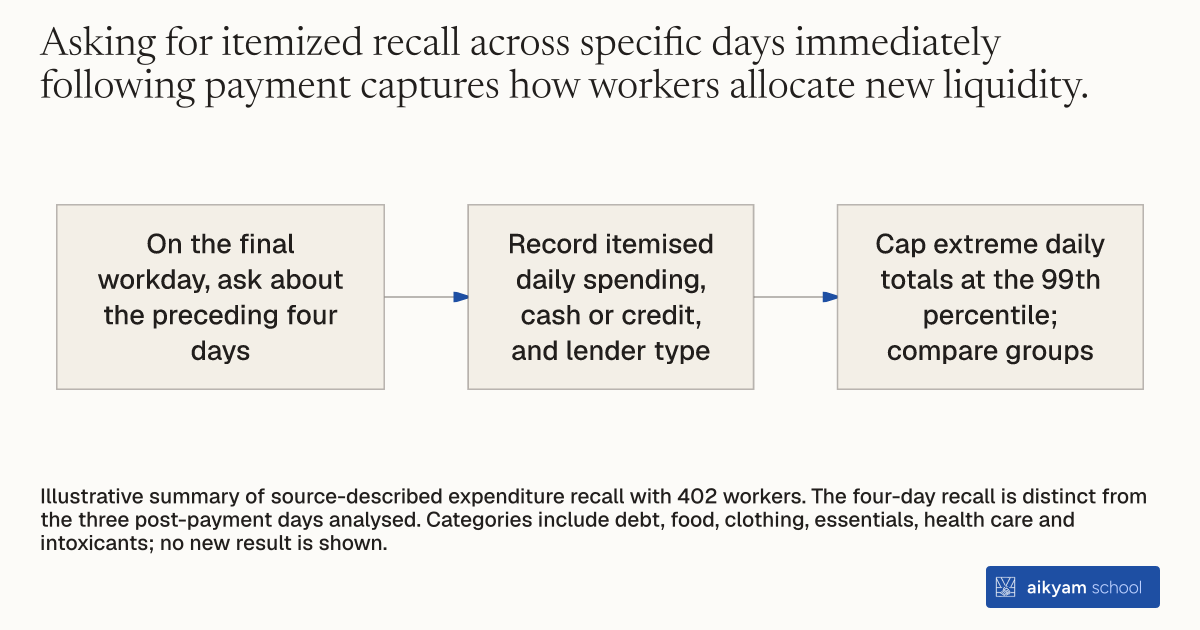
- On the final workday, ask about the preceding four days
- Record itemised daily spending, cash or credit, and lender type
- Cap extreme daily totals at the 99th percentile; compare groups
Illustrative summary of source-described expenditure recall with 402 workers. The four-day recall is distinct from the three post-payment days analysed. Categories include debt, food, clothing, essentials, health care and intoxicants; no new result is shown.
See source →How
When to use
Quantify how casual wage laborers utilize cash infusions across debt settlements and household spending following an early wage disbursement. It resolves the problem of verifying whether early earnings relieve liquidity constraints or go toward non-essential items. It serves researchers, policy evaluators, and payroll managers assessing the real-world financial impacts of wage timing interventions.
Audit post-disbursement spending and debt settlement behavior by administering a structured 4-day daily recall expenditure survey at contract end.
- Administer a structured expenditure recall survey to all participants on the final workday of the employment contract.
- Prompt participants to recall daily expenditures made on each of the preceding four days across categorized item blocks, including loan repayments, store credit, food, clothing, household essentials, medical care, and intoxicants.
- Record itemized spending amounts for each day separately, explicitly noting expenses paid in cash versus items obtained on credit.
- Record whether payments went toward institutional loans, private lenders, or local grocery store credit.
- Winsorize daily spending totals at the 99th percentile to handle extreme spending outliers before calculating treatment impacts.
Why it works
Comparing treated workers against control workers isolates the immediate financial relief generated by the cash infusion.
Example
At the end of two-week contract rounds in Odisha, India, survey staff administered a 4-day expenditure recall survey to 402 manufacturing workers. Workers receiving an interim cash payment increased total spending over three days by Rs. 371 (65% increase), with loan repayments rising by Rs. 271 (287% increase) and household spending rising by Rs. 150 (40% increase) relative to control workers.
About the study
Participants
402 male casual wage laborers in rural Odisha, India (1,160 worker-day observations across 3 post-payment days).
Study Design
Structured 4-day daily recall survey administered on the final contract day comparing treated workers (receiving interim cash on Day 8 or 9) against control workers (paid on Day 12).
Results
In the 3 days post-payment, cash-infused workers increased loan repayments by Rs. 271 (287%, p<0.001) and household expenditures by Rs. 150 (40%, p<0.001), with total expenditures rising by Rs. 371 (65%, p<0.001).