Research procedure
Compare household spending over time
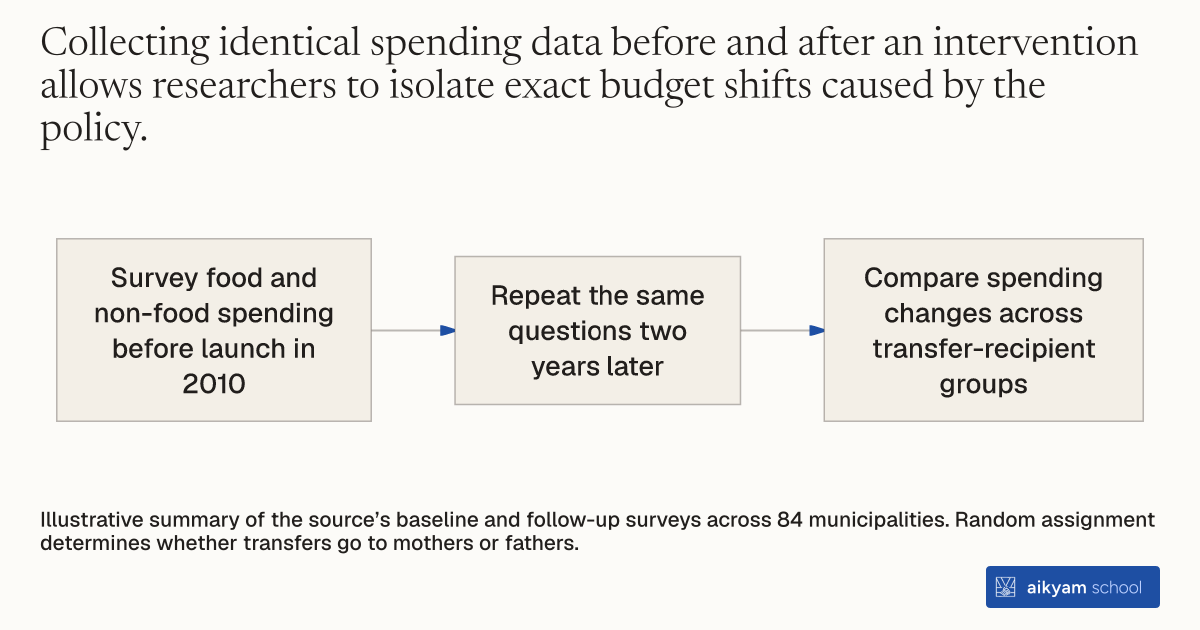
- Survey food and non-food spending before launch in 2010
- Repeat the same questions two years later
- Compare spending changes across transfer-recipient groups
Illustrative summary of the source’s baseline and follow-up surveys across 84 municipalities. Random assignment determines whether transfers go to mothers or fathers.
See source →How
When to use
Researchers want to evaluate how an income intervention alters spending behavior across families. Simple administrative tracking cannot show how households adjust their internal budgets or spending choices. Administering structured expenditure surveys before and after an intervention measures shifts in consumption patterns.
Evaluate program impacts on family spending by conducting structured household expenditure surveys at baseline and follow-up across target municipalities.
- Design a comprehensive survey measuring detailed household spending on food and non-food items.
- Conduct baseline household surveys across 84 municipalities prior to program implementation in 2010.
- Re-survey the same households two years later using identical expenditure questions.
- Compare baseline and follow-up spending patterns between treatment and control groups to determine budget shifts.
Why it works
Comparing treatment and control groups controls for broader economic trends affecting household consumption.
Example
In North Macedonia, researchers surveyed households across 84 municipalities in 2010 before launching a national cash transfer program and re-surveyed them two years later. Targeting cash transfers to mothers increased the household budget share spent on food by 3.9 percentage points compared to a 55.1 percent spending baseline when fathers received payments.
About the study
Participants
Low-income households living in poverty eligible for social assistance across 84 municipalities in North Macedonia.
Study Design
Randomized experiment using baseline surveys in 2010 and follow-up surveys two years later across 84 municipalities assigned to male or female transfer recipients.
Results
Targeting transfers to mothers increased the food expenditure share by 3.9 percentage points over a 55.1 percent baseline, raising the food budget share by 7 percent on average.